Cannabis in the treatment of a serious disease that affects our little dogs
The absence of vaccination in the puppy phase and throughout life can bring serious consequences to the animal
Published at 06/22/2025We know that Brazilians always find a way, but when this negligence manifests itself in the lack of proper pet vaccination, it crosses boundaries. The absence of vaccination in the puppy phase and throughout life can bring serious consequences to the animal — one of them is the perpetuation of infectious diseases, such as canine distemper.
Canine distemper is an infectious disease caused by the CDV (Canine Distemper Virus), which affects domestic dogs. The virus has a strong immunosuppressive capacity, leading to severe neurological and systemic manifestations. Transmission occurs through secretions and excretions of infected dogs and other animals.
In puppies, the absence of vaccination protection allows the virus to multiply and spread systemically and neurologically. The neurological manifestation is the most severe, as it involves viral replication in neurons and glial cells, which among their various functions play a role in preserving and nourishing neurons. The neurological manifestation of the disease can cause necrosis in the gray matter and demyelination in the white matter of the brain.
This results in involuntary movements and can even lead the patient to a coma. In other words, when the disease does not progress to death, it usually leaves sequelae that negatively influence the animal's quality of life. The worst part is that the available treatment is not specific, limited to managing the presented clinical signs.
It is in this context that Cannabis can play an important role. Although some are already discussing the possibility of using Cannabis during the active phase of the disease, it can be considered as an option to reduce the sequelae left by this dreadful disease. See two cases treated at the Veterinary University Hospital of the Federal University of Santa Maria (HVU-UFSM) and treated with cannabis oil.
Case 1. Myoclonus
A one-year-old mixed-breed female dog was adopted by a couple who noticed the negative influence of distemper sequelae on the animal's quality of life.
Myoclonus consists of involuntary, rapid, and sudden muscle movements. Conventional treatments usually involve acupuncture, physiotherapy, use of medications to control spasms, or stem cell therapy.
Although the animal did not show behavioral changes, the owners noticed limitations in daily activities such as difficulty in eating, climbing on the sofa or bed, as well as difficulty in avoiding obstacles on the floor, such as toys or even a simple step.
At the time, we did not have access to a THC-rich or balanced oil for a greater neuromodulatory effect. Therefore, a broad-spectrum Cannabis oil rich in cannabidiol (CBD) 4% was offered. In the first week of treatment, a significant decrease in myoclonus was noticed.
Furthermore, throughout the treatment, the animal showed continuous improvement, with greater ease in eating, avoiding obstacles, and being able to climb up and down the sofa and bed — something it had never been able to do before.
We know that cortisol acts as a negative modulator of the endocannabinoid system (ECS), a fact also observed in this patient. The patient was taken to the beach by the owners during a trip, but became familiar with the place. Thus, the clinical case regressed, and the patient began to show some limitations again.
To try to reactivate the ECS, a pause in the cannabis treatment was taken, and a week later, the treatment was resumed gradually. However, this time, the evolution of the clinical case was not as significant and satisfactory as before, but the animal no longer had limitations in its daily life, which left the owners equally satisfied. The treatment was maintained for a year and then discontinued, maintaining the animal's quality of life without regressions since then.
Case 2. Locomotor Dysfunction
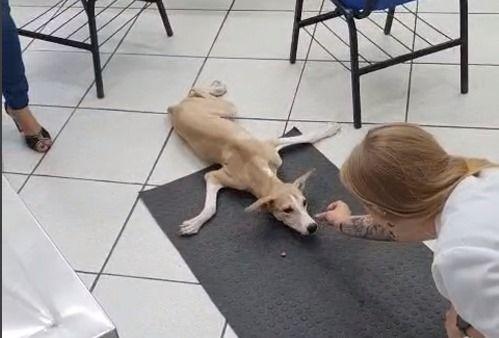
An eleven-month-old mixed-breed female dog, with a history of having previously contracted distemper, had difficulty walking (ataxia) as a sequel, hence the unsteady gait. The animal had already undergone treatment with phenobarbital and physiotherapy, but without a satisfactory response, including maximum-level electrotherapy without response. The case was considered irreversible by several professionals.
Cannabis was used after trying other treatments that did not yield the expected response; Watch the video:
The owner also reported that the animal showed excitement and intense vocalization at night, which led to the prescription of a broad-spectrum Cannabis oil rich in CBD 3%, combined with home physiotherapy.
During the treatment, there were episodes of clinical regression where euthanasia was recommended by three veterinarians, but the owner maintained hope, mainly because the animal had a good appetite.
Four months after starting the cannabis therapy, the owner sent us a video in which the animal not only walked but also ran freely playing with another animal.
See the benefits of cannabis for animals with distemper sequelae:
Faced with the possibility of the animal being able to move freely, the oil profile was changed to a balanced 3%, offered for another treatment cycle.
The animal currently remains stable and does not require continuous treatment.
Distemper remains endemic in Brazil, despite the availability of effective vaccines. Given this reality, Cannabis oil can represent a therapeutic option for distemper sequelae, thus avoiding the euthanasia of animals and offering a dignified quality of life to surviving animals and peace of mind to their owners.
Carol Mariga is a veterinarian graduated from UFSM, where she also completed a master's degree and is currently pursuing a doctorate, deepening her knowledge in animal health. She works as a prescribing veterinarian at ASCAMED Brasil, contributing to therapeutic solutions and well-being for pets. In addition, Carol is a postgraduate student in Cannabis sativa by SBEC, expanding her expertise in veterinary phytotherapy with a focus on cannabis-based compounds.