Textile Waste and Hemp: The sustainable opportunity Brazil is missing out on
Despite high textile waste in Brazil, the country overlooks the sustainable and economic potential of hemp, an ecological, resistant, and underutilized fiber due to lack of regulation
Published at 08/03/2025The fashion industry is one of the most influential and polluting on the planet. In contrast, regarding fabric disposal, research indicates that global waste amounts to US$ 500 billion per year.
The sector generated R$ 215 billion in 2024 in Brazil, according to ABIT (Brazilian Textile and Apparel Industry Association), representing a growth of approximately 7% compared to the previous year [1]. Another important fact: 4 million tons of textile waste are discarded annually in the national territory, and this significant volume of waste is driven by excessive consumption and low rates of fabric reuse and recycling — obstacles to competitiveness and innovation.
The environmental impact from textile disposal is highly significant, contributing to water pollution and waste generation in landfills. This waste brings about a significant economic loss. In Brazil, this represents, in each household, an average disposal of 44 kilograms of clothing and footwear in 2024. Most of the discarded waste is still composed of organic matter (45%), followed by dry waste (35%) and textile waste (6%). On the other hand, separate and dedicated textile collection systems are underdeveloped and do not capture all textiles placed on the market [2].
Textile Industry from Cannabis sativa
In the textile industry from Cannabis sativa, the advantages of hemp over cotton and other materials stand out. Hemp, obtained from the plant Cannabis sativa, is used to produce high-quality fabrics, being more ecological and less water absorbent than cotton [3].
Historically, hemp fabrics have been known since the eighth millennium BC and were widely used until the introduction of the Marihuana Tax Act in the US in 1937 [3]. Experts claim that hemp fabrics are more durable, stretchable, warm, delicate, and have high water absorption compared to cotton fabrics [3].
Legalization and Industry Growth
The recent legalization of hemp in several countries has boosted its use in the global textile industry [4]. Hemp is one of the strongest natural fibers, offering better UV protection and being considered sustainable due to its hypoallergenic, antiviral, antibacterial, and antimicrobial properties [5]. Additionally, it requires less water to grow and regenerates the soil [5].
Hemp: The Sustainable Fiber that Can Transform the Future
From the perspective of applications and research, hemp can be used in blends with other fibers or as 100% content in textiles such as clothing, bedding, footwear, and home articles [6]. Research is evaluating hemp for fiber reinforcement in new composite applications, where sustainability, fiber strength, and cost benefits are intriguing [7].
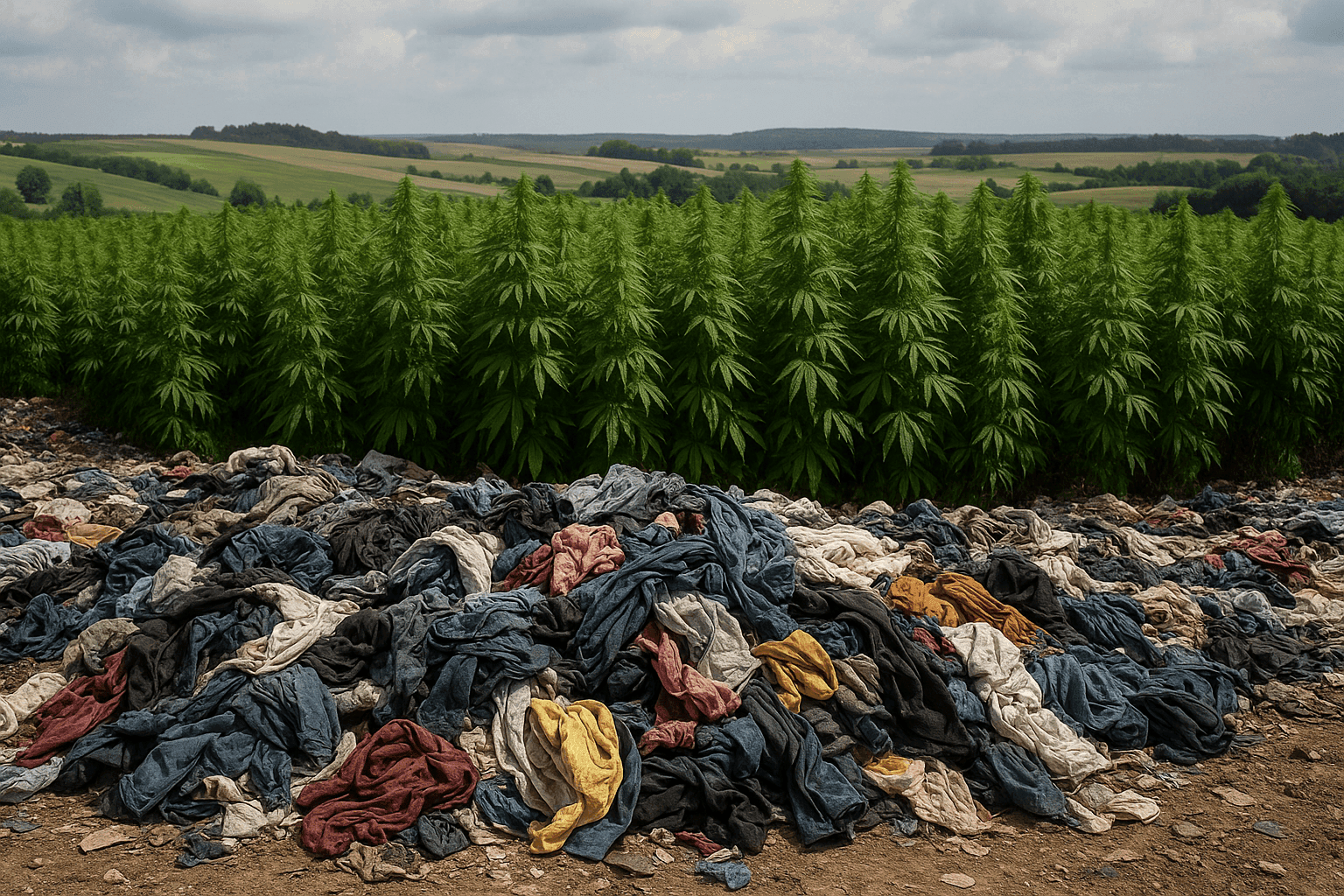
While tons of fabrics are discarded, a highly promising raw material remains underutilized: industrial hemp. Derived from the plant Cannabis sativa, hemp has long, strong, and biodegradable fibers, ideal for textile production.
Furthermore, its cultivation is highly sustainable: it requires less water than cotton, grows rapidly, does not require pesticides, and also regenerates the soil, reducing the use of fertilizers for the next crop, as hemp is one of the plants that most sequester carbon from the atmosphere, fixing essential nutrients for the development of the next planting. Despite its potential, hemp still faces legal barriers in Brazil and cannot be legally cultivated. This prevents the country from accessing a booming market.
According to Thiago Zilio, president of ICTCB - Cannabis Science and Technology Institute Brazil, "Despite small advances in fabric waste reuse, the sector's major problem is still fast fashion, responsible for a huge production of disposable and synthetic clothing, which end up becoming microplastics in the environment."... "Hemp emerges as a sustainable alternative, capable of increasing the durability of pieces and offering thermoregulatory and antibacterial properties, as well as being biodegradable — unlike synthetic fibers, which pollute and have a short lifespan," says Zilio.
Challenges and Consumer Education
Adequate consumer education is a major challenge for the hemp industry. There is a lot of misinformation on the subject, generating an undeserved bad reputation [6]. In the market, there are companies focused on developing the best hemp-derived products and educating consumers about their real benefits.
Another challenge is distinguishing between real and fake products in the market, where genuine ones are science-based and ensure that consumers receive quality and safety-assured products.
Misconceptions about hemp also pose a significant challenge. It is up to the industry, with the support of the state and promotion of research and science, to work on changing these perceptions in society and show that hemp products are a real alternative to the national and international textile market.
Perspectives: A Billion-Dollar Growing Market
The global hemp fiber market was valued at US$ 7.55 billion in 2022 and is expected to reach an impressive US$ 73.55 billion by 2030, with a Compound Annual Growth Rate (CAGR) of 33.57% [8]. Meanwhile, the industrial hemp market as a whole is projected to grow from US$ 2.6 billion in 2024 to US$ 5.84 billion in 2029, with a CAGR of 17.56% [9].
In Brazil, a study by Kaya Mind estimates that hemp regulation could generate 117,000 jobs and move R$ 26.1 billion in just four years [10]. This is not to mention the environmental and social benefits of a cleaner and more decentralized production chain. These combined factors make non-pharmacological hemp a more sustainable and efficient option for the textile industry, helping to reduce fabric waste.
Why Hasn't This Revolution Arrived Yet?
The answer to the sustainable textile non-use of hemp may lie in the lack of regulation and social stigma. The absence of clear public policies on hemp cultivation and use hinders investments, inhibits innovation, and keeps Brazil out of a strategic market. Meanwhile, countries like China, France, and Turkey are advancing in fiber production and export. Another point of concern is the dependence on imports, leading to higher costs and obstacles in domestic production.
From a scientific standpoint, a Scientific Regulation working group was recently created, composed of experts from across the country to propose regulatory advances for medicinal cannabis and industrial hemp purposes. The goal is to compose a Technical Note in up to five points per thematic area, with the participation of highly recognized entities, such as EMBRAPA - Brazilian Agricultural Research Corporation, 31 research institutions, 29 universities like UNESP, and SBPC - Brazilian Society for the Advancement of Science [11]. Thus, the initiative, albeit belated and out of sync with global advances, is commendable.
Hemp — The Open Window to Sustainable Textile Innovation
Ultimately, hemp represents a concrete solution to the environmental and economic challenges of the textile industry. Ignoring its potential is wasting a golden opportunity to transform the sector into a more circular, efficient, and sustainable model.
Brazil has everything to lead this green revolution — fertile soil, favorable climate, industrial, technological, scientific capacity, and a growing consumer market for sustainable products. What is lacking is interest, knowledge, political will, and strategic vision.
Tatiane Rodrigues Ramos, MSc. is technical vice-director - ICTCB (Cannabis Science and Technology Institute Brazil).