When protecting the skin means activating its biological intelligence
Nano-CBD and sun protection: A new approach that activates the skin's internal mechanisms against sun damage
Published at 08/10/2025
Cannabidiol (CBD) is already part of dermatological prescriptions, but a recent discovery redefines the concept of intelligent photoprotection.
A clinical trial published in the Journal of the American Academy of Dermatology (JAAD, 2024) demonstrated that a topical formulation with nanoencapsulated CBD is not only safe but protects the skin against molecular damage caused by UVA radiation, a type of constant radiation that penetrates glass and clouds, and is directly related to premature aging and cumulative genetic damage.
The study was conducted with 19 volunteers who applied a formulation with nano-CBD (Z-pod™) or placebo on their buttocks for 14 days. Subsequently, the areas were exposed to a controlled dose of UVA, simulating chronic sun exposure.
Observed results:
- - 21% reduction in redness (erythema) after irradiation;
- - Reduced epidermal thickening, one of the first signs of damage;
- - Reduced nuclear and mitochondrial DNA lesions;
- - Less activation of OGG1 (enzyme associated with repairing oxidative DNA damage);
- Reduced deletions in the ND1 and ND4 genes, which are mitochondrial markers related to skin aging and cancer.
Unlike filters that only block radiation, CBD acted directly within the cells, modulating inflammation, controlling oxidative stress, and protecting the cellular nucleus. It is a silent and deep action, focused on the biological resilience of the skin.
We are finally moving away from surface cosmetics and advancing towards functional dermatology.
And phytocannabinoids, when well formulated, play a relevant role in this new territory: that of prevention preceding visible damage.
More than an antioxidant, CBD has shown to be a bio-intelligent active ingredient, capable of positively interfering with cellular processes that determine skin longevity and integrity.
This study does not close the discussion. On the contrary, it paves the way for a new generation of dermocosmetics with anti-inflammatory, antimutagenic, and antioxidant action, acting with depth, specificity, and safety.
Cannabis in dermatology is a paradigm shift.
Scientific reference:
McCormick E, Han H, Abdel Azim S, et al.
Topical nanoencapsulated cannabidiol cream as an innovative strategy combating ultraviolet A–induced nuclear and mitochondrial DNA injury: A pilot randomized clinical study.
J Am Acad Dermatol. 2024;91(5):855–862.
- PubMed (abstract + free access):
“Topical nanoencapsulated cannabidiol cream as an innovative strategy combating UV-A–induced nuclear and mitochondrial DNA injury: A pilot randomized clinical study” – J Am Acad Dermatol. November 2024, vol. 91(5):855–862
jaad.org, pubmed.ncbi.nlm.nih.gov, em-consulte.com - George Washington University (PDF access via institutional repository):
Volume and page corresponding to the full article abstract and DOI 10.1016/j.jaad.2024.06.088
pubmed.ncbi.nlm.nih.gov, src.himmelfarb.gwu.edu, em-consulte.com
Figure 1:
Samples treated with nanoencapsulated CBD (nCBD) showed a reduction in the immunohistochemical staining of 8-oxoguanine glycosylase (OGG1) in the cytoplasm and nucleus compared to samples treated with the vehicle control (VC).
OGG1 is a DNA repair enzyme that removes 8-hydroxyguanine, a common lesion induced by UV radiation in DNA.
Representative immunohistochemical (IHC) images of the epidermis exposed to UV radiation from one of the patients, after treatment with nCBD, can be seen here, compared to the epidermis exposed to UV after treatment with VC in Figure 2. Up to 10 high-power fields (400×) were analyzed on each stained slide by three independent evaluators, examining the expression of OGG1.
Statistical analysis with an unpaired t test revealed a significant reduction in the number of nuclear and cytoplasmic OGG1 expressions induced by UV in samples treated with nCBD compared to the control (VC) (P = 0.009).
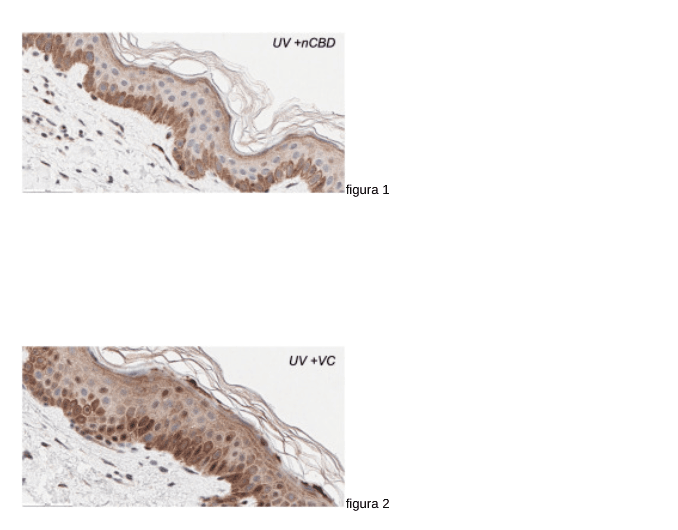
Figure 2
Samples treated with nanoencapsulated CBD (nCBD) showed a reduction in the immunohistochemical staining of 8-oxoguanine glycosylase (OGG1), both in the cytoplasm and nucleus, compared to samples treated with the vehicle control (VC).
OGG1 is a DNA repair enzyme responsible for removing 8-hydroxyguanine, a common lesion induced by UV radiation.
A representative immunohistochemical (IHC) image of the epidermis exposed to UV radiation from one of the patients, after treatment with VC, is shown here, while the epidermis exposed to UV after treatment with nCBD can be seen in Figure 1.
Up to 10 high-power fields (400×) were analyzed on each stained slide by three independent evaluators, evaluating OGG1 expression.
The statistical analysis, using the unpaired t test, revealed a significant reduction in nuclear and cytoplasmic OGG1 expression induced by UV in samples treated with nCBD compared to VC (P = 0.009).
Dr. Ludmila Militão is a physician, researcher, and professor of Dermatology at the Postgraduate Program of Afya Medical Education. She works at the interface between science, clinical practice, and integrative and regenerative therapies applied to aesthetic care and the treatment of dermatological diseases, with an emphasis on advances in medicinal cannabis.