Cannabis Residue Reduces Methane Produced by Cattle by up to 34%, New Study Shows
Research indicates the potential of cannabis residue in reducing methane, while experts assess safety, applicability, and impacts on animal welfare

Published on 11/19/2025

Image: Canva Pro
A groundbreaking study, published in BMC Veterinary Research, has highlighted the potential of the residue from the plant Cannabis sativa L. — composed of leaves and stems that would typically be discarded — as a promising solution for the reduction of methane emissions in livestock farming. The in vitro research showed that including cannabis residue powder (CSR) in ruminants' diet can reduce gas emissions by up to 34.87% after 24 hours of fermentation, without compromising food digestibility. The best result was achieved with a 2% CSR supplementation.
The Blocking Action of Cannabinoids
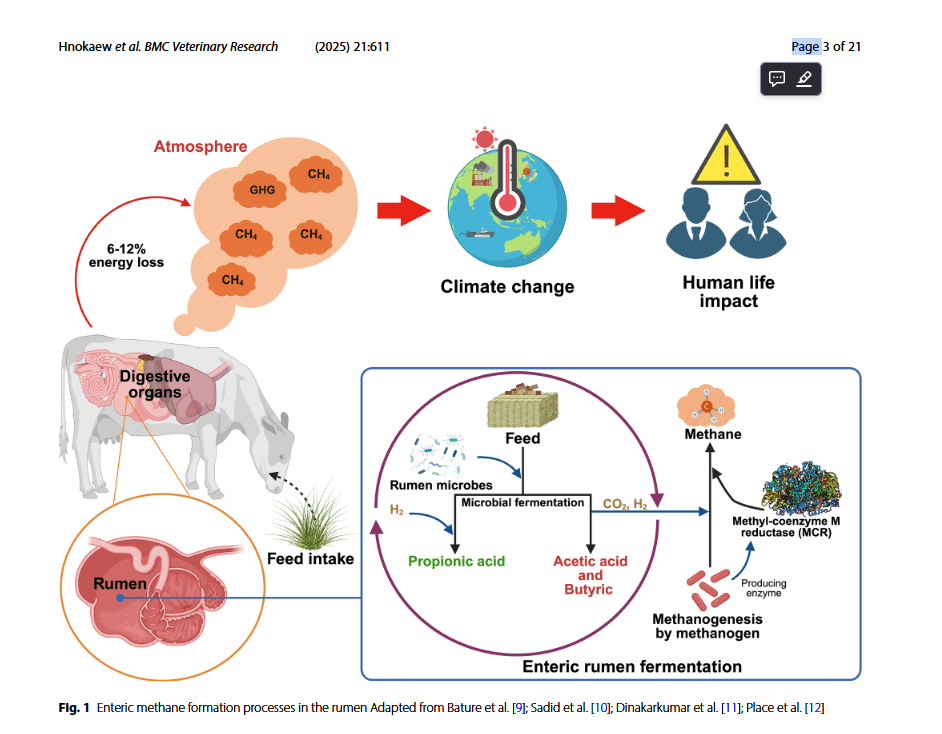
The efficacy of the residue lies in the action of its cannabinoids, especially CBD and THC. Through molecular modeling, scientists found that these compounds can bind to methyl-coenzyme M reductase (MCR), the crucial enzyme for methane production in the rumen. This binding is stable, suggesting that cannabinoids act as natural inhibitors of methanogenesis, directly interfering with the biochemical reaction. Additionally, supplementation altered the rumen's microbiota, reducing the population of methane-producing archaea (Methanobacteriales) and increasing the proportion of propionate, a fatty acid that redirects hydrogen, reducing its availability for $\text{CH}_{4}$ formation. The authors emphasize that the methane reduction occurred "even without impairing fermentation or nutritional parameters".

The Confrontation with the Brazilian Reality
Despite the encouraging results, applying this discovery in Brazil faces serious barriers. Veterinarian and researcher at Embrapa, Daniela Bitencourt, explains that while the process is "technically feasible, but currently, in Brazil, still hypothetical", the initial obstacle is legislation: "Cannabis cultivation in Brazil on a large scale is not allowed, which would be the first regulatory barrier."
Food safety is also a central point of concern. For any potential approval, it would be necessary to "develop more robust studies, specifically testing cannabis with different THC levels, focusing on food safety and traceability." The researcher highlights the concern about cannabinoid residues in the food chain. While there are indications that they "disappear after a certain period of time", Bitencourt emphasizes that "we still don't have many answers regarding the presence of cannabinoids in milk or meat." Hence, "more robust studies... are crucial for us to define these safety levels."
Potential Indirect Benefits for the Animal
From a physiological standpoint, the methane reduction and propionate increase — an indicator of better energy utilization — bring a positive outlook. Bitencourt states that it is "physiologically plausible that a reduction in methane associated with an increase in propionate brings indirect benefits (better energy utilization)". However, she points out that "we still don't have a clear demonstration of clinical benefit for the animal", warning that these effects would need to be confirmed in long-term trials.
Climate Implications and the Future of Livestock Farming
The study points to an ecological and cost-effective alternative for the livestock sector, one of the main global methane emitters, a gas with very high warming potential. Utilizing cannabis residues, which currently hold no economic value, as a "strategic tool" for global livestock farming could contribute to "sustainability goals and greenhouse gas reduction." However, the researchers stress that the next steps depend on in vivo trials to validate efficiency, safety, and dosage in real herds.