Doping Control and Cannabis: What WADA Allows in Competitions
Contrary to popular belief, THC is allowed in urinary concentrations up to 150 ng/mL, while CBD is not on the list of prohibited substances

The relationship between cannabis use and doping control has raised many questions among athletes and sports professionals. Contrary to the popular belief that only cannabidiol (CBD) is allowed, the World Anti-Doping Agency (WADA) establishes specific criteria for the use of tetrahydrocannabinol (THC), the main psychoactive compound in cannabis, during competitions.
According to WADA, THC is only prohibited during the competition period, meaning when an athlete is participating in official events. However, the prohibition is only applied when the urinary concentration of THC exceeds 150 ng/mL. This limit was significantly increased in 2013, as it was previously 15 ng/mL. This increase reflects a more comprehensive approach, taking into consideration that higher levels of THC would only be detected in frequent users or in cases of recent high use, which could impact the athlete's performance.
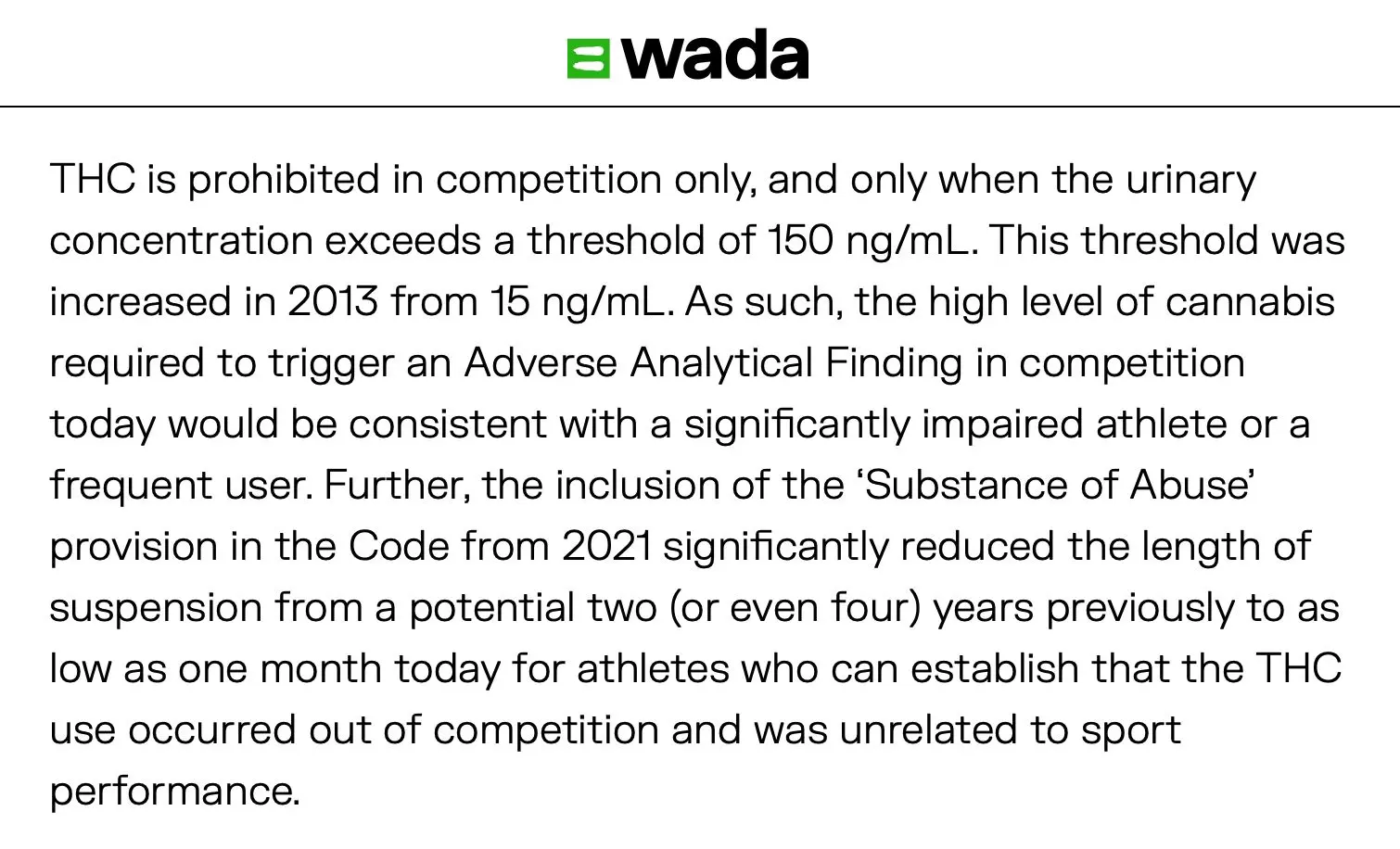
In addition, with the update of the WADA Code in 2021, THC was introduced as a "Substance of Abuse." This reduced the penalties associated with its use. If an athlete can prove that THC use occurred outside of competitions and did not impact their sports performance, the suspension can be reduced from two or four years to just one month.
The Stigmas Still Exist
However, even with WADA regulations in place, there is still a lot of prejudice surrounding athletes who use the plant, as Pedro 'Peu' Guimarães, entrepreneur, amateur triathlete, former adventure racer, and co-founder of Atleta Cannabis, a platform focused on the topic, recounts.

Peu recalls an episode during a triathlon race in São Paulo when, according to him, he was "randomly" selected to undergo a doping test. Upon arriving at the test location, he noticed that many of the athletes present also used medicinal cannabis. "Triathlon, which is the only amateur sport that follows the same doping rules as professional sports, still promotes a real witch hunt against those who use medicinal cannabis," he comments.
Peu emphasizes that prejudice persists even among amateurs, and there is no real concern to verify if cannabis offers a competitive advantage, but rather to persecute users of this type of therapy. "No one asks why a person uses medicinal cannabis," concludes the triathlete, referring to the lack of understanding about the therapeutic benefits of the treatment for athletes.