Roots of Change: the research that connects cannabis, animal welfare, and sustainability in the Serra Gaúcha
The study aims to democratize knowledge, unite university, science, and field, and promote sustainable development in the region


Amidst the cold and fertile fields of Campos de Cima da Serra, in Rio Grande do Sul, a silent movement is starting to take shape. Researcher Derek Zarruq, specialist in Environmental Sustainability Practices (UERGS), postgraduate student in Cannabis Sativa (SBEC), and master's student in Environment and Sustainability (UERGS), decided to turn curiosity, courage, and purpose into a research that connects cannabis, sustainability, and animal welfare.
Based in São Francisco de Paula (RS) and a civil servant at the Municipality's Department of Agriculture, Derek launched a simple digital form at the beginning of October, accompanied by a direct message on social media: "Hey folks, I'm asking for some help here. I'm conducting a master's research on cannabis and animal welfare, to create a Working Group here in the mountains. If you can lend a hand, just answer 2 multiple-choice questions."
The result? In less than 24 hours, 170 responses, all supporting the research. "Half of the people even took the time to leave spontaneous comments, even when it wasn't mandatory. That really surprised me," said Derek, visibly moved.
Democratizing knowledge and breaking barriers
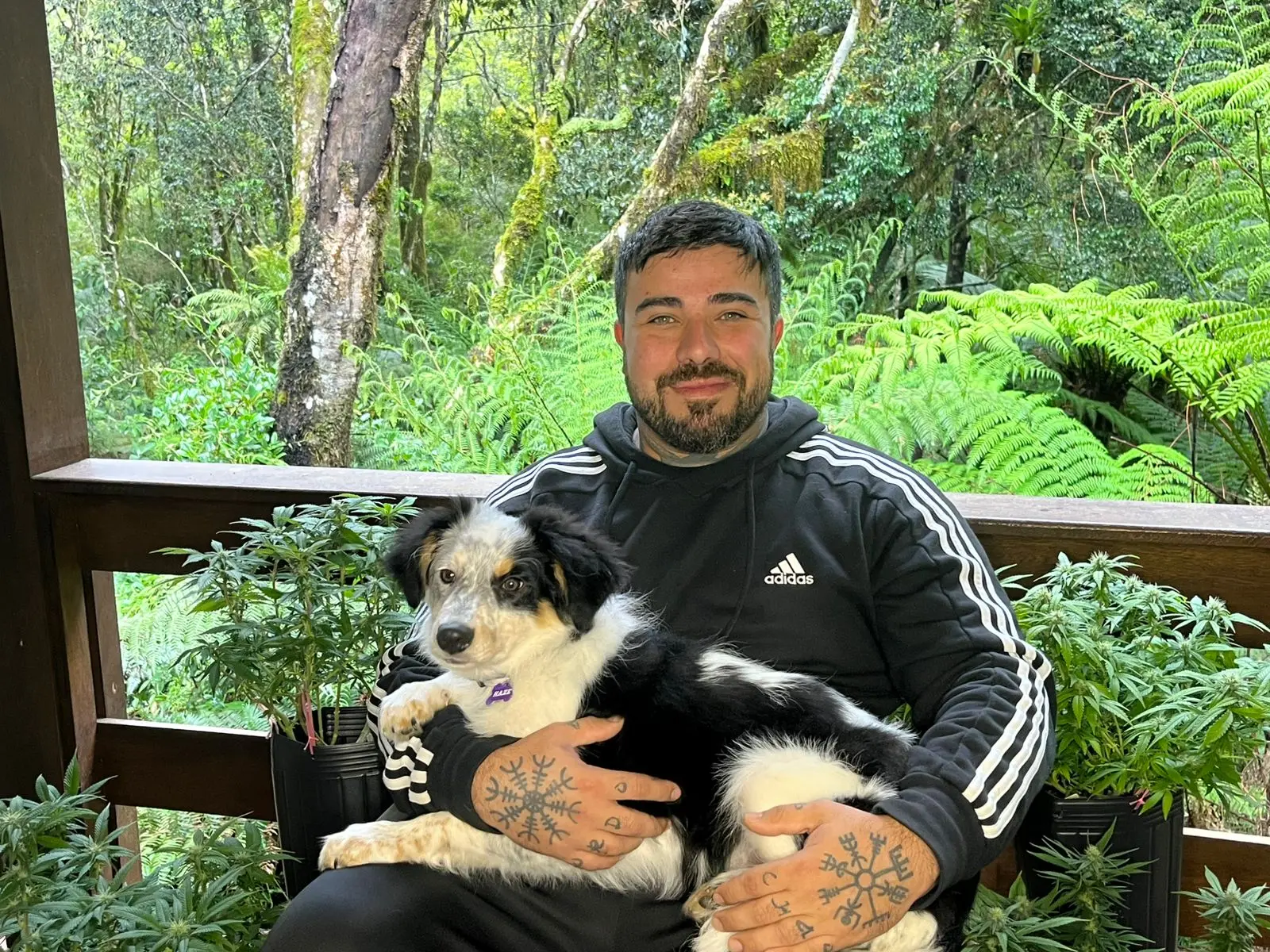
The project was born with a clear purpose: to democratize access to knowledge about cannabis associativism, especially in territories where the topic still faces resistance. "The master's degree started with the idea of taking science and information beyond the university walls," he explains.
Derek sought heavyweight institutional support: Prof. Dr. Leonardo Beroldt, from the Postgraduate Program in Environment and Sustainability (PPGAS) at the State University of Rio Grande do Sul (Uergs), agreed to guide him in the study, ensuring academic and ethical support to move forward with the topic. "Having Professor Leonardo as my advisor gave me confidence. I knew that with his endorsement, the project wouldn't be easily blocked," he states.
But the researcher also carries a deep personal motivation. "My first contact with marijuana was at 17, when I planted and smoked what I cultivated myself. I was afraid because everything said about the plant was negative. Today, at 38, I have no more fear. I want to contribute to making access and information reach those in need," he says.
Cannabis and field: a possible bridge
Working in the heart of rural areas, Derek realized that animal welfare could be the key to bringing the field closer to the cannabis agenda. "Our municipality is essentially agricultural. Over half of the GDP comes from livestock farming. And one of the main factors of loss in the sector is animal stress. Why not consider cannabis as an ally?" he questions.
The producers' adherence to the research shows that there is more openness than expected. "I sent the form to religious groups, civil servants, agronomy professionals, livestock farmers, and even research groups. I expected resistance, but the support was total. I believe that economic interest plays a role in this, rural producers understand the potential that cannabis can have for the future of agriculture," he states.
In the horizon, Derek envisions a consortium between UERGS, SBEC (Brazilian Society of Cannabis Studies), and the municipal government, uniting university, science, and public authorities to strengthen research and create a Working Group on Cannabis and Animal Welfare.
"This tripartite consortium can transform the debate. The university brings technical rigor, SBEC provides scientific and legal support, and the municipality has the power to promote public policies and open legal pathways. Together, we can take a leap towards sustainability and applied science in the field," he argues.
A fertile territory, in every sense
The researcher's enthusiasm is accompanied by a keen eye for the region's particularities. "São Chico is a territory with great hydrological, agricultural, and logistical potential. Even in the floods that devastated the state, the impact here was minimal. We have fertile soil, good insolation, and plenty of space to think about regenerative agriculture," he points out.
And it is precisely at this point that cannabis fits strategically. "Potato is our main crop, but it contaminated part of the groundwater with heavy metals. Cannabis has the ability to capture these metals and restore the soil. So, in addition to animal welfare, we are talking about environmental restoration and sustainable development."
With the growing support of the community, the watchful eye of the university, and the backing of scientific institutions, Derek believes that the project can become a milestone. "The research is the first step. The next one will be to turn this support into public policy, into a lively and productive territory. The mountains are ready for this conversation, and perhaps the country as well," he concludes.