UFV research evaluates the use of hemp fibers to reinforce recycled paper
Partnership with startup Buds INC investigates the physical and chemical properties of the material to extend the lifespan and resistance of recyclable products

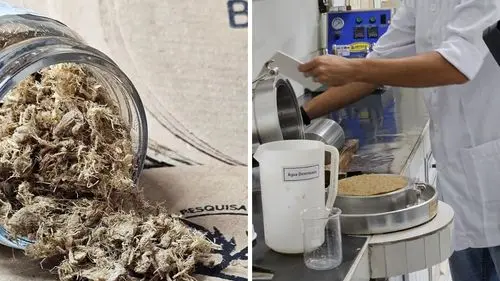
A research project developed by the Department of Forestry Engineering at the Federal University of Viçosa (UFV), in partnership with the startup Buds INC, is investigating the properties of hemp fibers to reinforce recycled paper.
Present in the stems, branches, and roots of plants of the Cannabis genus, these structures are the focus of the initiative that seeks to understand their technological potential. Among the main attributes studied by the researchers are the fiber length and its high mechanical strength.
Application of hemp fibers in the paper industry
Following the initial characterization, the project began to evaluate the use of hemp fibers as a reinforcing element in the production of different types of paper. The study's special emphasis is on the recycled paper industry.
This approach is necessary because conventional cellulose fiber has a finite number of recycling cycles. With each new reuse, the fibers become shorter and more fragile, resulting in a progressive loss of paper mechanical strength.
"It is precisely at this point that the material comes in. The controlled addition of hemp fibers to the recycled pulp allows for the recovery of the paper's original strength," says Gustavo Baêsso, a forestry engineer and project researcher.
According to the expert, the results may exceed the initial expectations. "In some cases, it is possible to achieve mechanical properties superior to the initial material, significantly extending its lifespan and performance," Baêsso concludes.
Promising results
Currently, the project is in the final phase of consolidating the mechanical results of papers produced with different levels of hemp fibers. The data obtained will be submitted for publication in specialized scientific journals.
The dissemination of these results aims to contribute to the advancement of technical knowledge in the field of fibrous materials. Additionally, it strengthens the forest products sector with robust scientific data.
The researchers highlight the great potential of this innovation for Brazil, one of the world's largest producers of recycled paper and cardboard. The use of hemp fibers as reinforcement represents not only technical and economic gains but also an important advancement in sustainability.
The technique enhances recycling efficiency by extending the paper's lifespan. Consequently, this helps reduce pressure on traditional forest raw materials, optimizing the available natural resources.
Innovations and patents beyond hemp fibers
Also involving Baêsso, UFV developed the minicutting technique. This first major innovation consists of a plant cloning technique that ensures a high rooting rate and reduces the production cycle.
In 2025, the researchers visited the United States to promote the project and the applications of hemp fibers. "Next year, the goal is to continue this process," explains the engineer.
The group also completed the patent filings for the technique in the United States, securing the intellectual property of the innovation. "We are just waiting for the documentation," Baêsso concludes.