1971: Decision made by U.S. president impacts Brazil
Audio recordings from the 1970s reveal statements from the former president of the United States; understand how the scenario initiated in the U.S. interfered with Brazil today

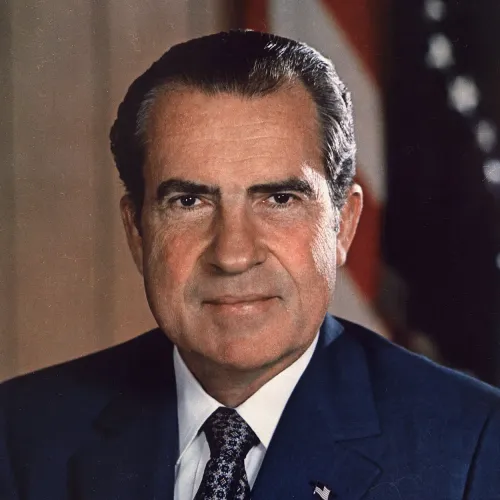
In 1971, then-President of the United States, Richard M. Nixon, described the use of illicit substances as "public enemy number 1." Following this declaration, various countries instituted the phenomenon known as the war on drugs.
Nixon was also responsible for implementing the federal government's drug classification system, deciding that cannabis should belong to Schedule I, a category reserved for substances considered highly addictive and with no proven medicinal value.
Over five decades, this classification resulted in millions of arrests, disproportionately affecting the Black population and hindering research on the therapeutic potential of cannabis.
Marijuana "is not particularly dangerous"
In March 1973, Nixon made a surprising confession during a meeting in the Oval Office. In front of a small group of advisors, he admitted that he knew marijuana "was not particularly dangerous," as published by The New York Times, which had access to recordings from that time captured by a secret recording system.
Nixon also expressed concern about the severe penalties Americans faced for marijuana-related crimes. "Penalties should be proportional to the crime," he stated during the conversation, calling a 30-year sentence imposed in a recent case he had learned about "ridiculous."
In another recording from 1972, Nixon can be heard telling a senior advisor that he was in favor of a "modification of penalties" while discussing drug-related crimes. "But I don't talk about that anymore," he remarked.
In the meeting the following year, Nixon was even more explicit. "I know that [marijuana] is not particularly dangerous, and most young people favor legalizing it. But, on the other hand, it's the wrong signal at this moment."
Historical context in the U.S.
In 1937, Congress passed the Marijuana Tax Act, which effectively criminalized the recreational use of cannabis and virtually halted research on its medical applications.
In 1969, the Supreme Court declared the law unconstitutional for violating protections against self-incrimination. However, a year later, Nixon again made marijuana illegal at the federal level by signing the Controlled Substances Act, which established a drug classification system.
The Nixon administration temporarily placed marijuana on Schedule I and appointed a commission to study its health risks. Nixon selected 9 of the 13 members of the commission. The group concluded that cannabis use "did not constitute a major threat to public health." Furthermore, it found no convincing evidence to support the widely held notion that marijuana would be a gateway to more dangerous drugs or a contributing factor to violent crimes.
The commission recommended the decriminalization of cannabis, suggesting that the government control its use through "persuasion, not prosecution." Nixon, however, ignored the recommendations and kept marijuana on Schedule I.
Butterfly effect
Author of the book "Fumo de Negro: the criminalization of marijuana in post-abolitionism," Luisa Saad explains that the prohibition of cannabis began in Brazil in 1932, with Decree No. 20,930, which criminalized the consumption and sale of the plant.
"The decades leading up to the prohibition were marked by a process of constructing this criminalization of marijuana and its users. Practices such as candomblé, samba circles, and capoeira, all rooted in the Black population, enslaved and later freed, were also criminalized," Saad comments.
After Nixon established the War on Drugs as an international standard, the situation in Brazil worsened, and according to Luisa, to overcome the current scenario in the country, it is necessary to establish a model of its own that fits the reality of the country and its population. As guidance, the historian believes that Brazil should promote reparations and amnesty for affected individuals, as well as include this population in the market.
According to the 18th Brazilian Yearbook of Public Security, in 2023 Brazil reached a record number of incarcerated individuals, totaling 852,010 detainees, which equates to about 420 prisoners per 100,000 inhabitants. The yearbook shows that the majority profile of the incarcerated is composed of men (86%), young people up to 30 years old (72%), with low education (67%), and Black individuals (68%).
"I believe in broad legalization for all uses of the plant. This way, we can explore therapeutic, adult use, and commercial possibilities, generating income for the state and the population," Saad states.
Important decisions
Last week, the 2nd Criminal Law Chamber of the São Paulo Court of Justice reclassified, from serious to medium, the offense attributed to an inmate who had been caught with 36.24g of cannabis upon returning from work.
"With this reclassification, the semi-open regime was restored, and furthermore, there is no longer any interruption in the calculation of sentences, recovering the days that had been lost," explains lawyer Luisa Matias, who worked on the case.
The first-instance court had considered the conduct serious, interrupting the interval for regime progression and determining the loss of remitted days. The defense appealed twice, arguing that the evidence was weak and insufficient to prove the offense.
Despite the Supreme Federal Court's (STF) decision to decriminalize cannabis users, the lawyer emphasizes that the situation in penal execution has not improved significantly. "We still live in a punitive reality, at least. In the three months following the STF's decision, little has changed," she concludes.