After winning at the Golden Globe, Brazilian cinema shines — and cannabis also takes the stage
Amid the celebration of Brazilian cinema with "The Secret Agent," we gather national productions that help understand the trajectory of cannabis in the country
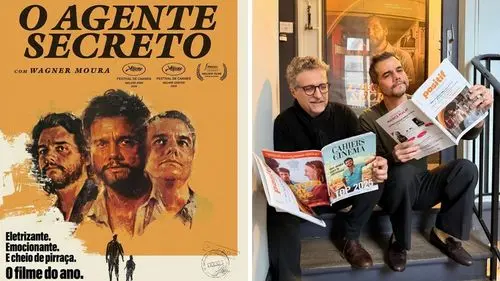
The Brazilian film industry gained worldwide prominence after the feature film "The Secret Agent" won two awards at the 83rd edition of the Golden Globe. The production won in the Best Foreign Language Film category and actor Wagner Moura was awarded Best Actor in a Drama Film.
Seizing this moment of international projection, Sechat highlights Brazilian works that address cannabis from medicinal, social, and political perspectives. Directors and screenwriters in the country have built a robust documentary collection on the subject.
Below, we list five national productions that document the evolution of the debate on the plant in Brazil.
The Holy Cannabis (2026) and hope
Scheduled to be released next Saturday (17) in Florianópolis, the documentary "The Holy Cannabis: a story of love and hope" narrates the seven-year journey of the Santa Cannabis Association. The narrative follows from the first artisanal oil extraction made by Pedro Sabaciauskis, president of the entity, to the current care of 30 thousand patients.
The work aims to foster public discussion on alternative treatments, analyzing the gap between social evolution and legislation. Sabaciauskis comments on the current scenario and political sluggishness.
"Little progress has been made on the political agenda, but the debate on medicinal cannabis has improved, maturing like society. Regulatory advances, however, have been few compared to the speed at which associations and the market as a whole advance," explains Sabaciauskis.
The Plant (2025): cannabis and quality of life
Produced by Drama Filmes, "The Plant" gathers testimonials on how medicinal cannabis acts in relieving symptoms and improving quality of life. The film explores the impact of therapy on family life, medicine, and scientific research, addressing the entire productive ecosystem.
Director Beto Brant highlights Brazil's strategic position on the global stage, citing supply through the Unified Health System (SUS). He emphasizes the importance of the Brazilian hybrid model.
"Brazil currently holds a prominent global position for being the first to offer oil for free through SUS, initially in the state of São Paulo. This hybrid arrangement projects a model with enormous potential. The film seeks to give visibility to this transformation and the protagonism of the associations," says Brant, who also participated in Deusa Cast and explained the reasons that led him to produce the film. Click here to watch the full episode.
Sofia's Other World (2023) and access to cannabis
Directed by Raphael Erichsen, "Sofia's Other World" documents the Langenbach family's struggle to ensure treatment for Sofia, who needs medicinal cannabis. The documentary exposes the legal barriers and prejudice faced by Margarete Brito and Marcos Langenbach, founders of the APEPI association.
The production highlights how Sofia's case set fundamental legal precedents for other patients in the country. The work also features analyses from experts, such as neuroscientist Sidarta Ribeiro, and political figures, such as federal deputy Henrique Vieira.
Illegal (2014): a milestone on cannabis
Considered a milestone in the public discussion on the subject, "Illegal: Life Doesn't Wait" portrays the bureaucracy faced by mothers of children with severe conditions who depend on cannabis. The film focuses on the quest for the legal right to use plant-based medicines, often the only viable alternative.
Tarso Araújo, journalist and director of the film, analyzes the longevity of the work more than a decade after its release. He emphasizes that the central theme is maternal love in the face of prejudice.
"The documentary remains relevant because it deals with a universal theme: a mother's love for her child and how far she can go for it. Humanity has realized that it was a mistake to prohibit all applications of cannabis. As prejudice persists, unfortunately, this is still a barrier to access," evaluates Araújo.
Smoke Screen (2010) and cannabis policy
Directed by Rodrigo Mac Niven, "Smoke Screen" was one of the first Brazilian documentaries to question current drug policy. The work discusses humanity's historical relationship with psychoactive substances and the industrial and medicinal use of cannabis.
Additionally, the film addresses the consequences of the "war on drugs" policy in major cities, with an emphasis on Rio de Janeiro. The production circulated in international festivals and is cited as a reference in the early Brazilian political movement on the subject.
Global panorama of cannabis in cinema
In addition to national productions, the theme is recurrent in global cinema. The documentary "The Scientist", for example, profiles Professor Raphael Mechoulam, a pioneer in isolating Tetrahydrocannabinol (THC) and cannabidiol (CBD) from cannabis.
Meanwhile, "Weed the People" (2018) focuses strictly on pediatric oncological medicinal use in the USA. "Based on Racial Facts" (2019), available on Netflix, explores the intersection between the plant, musical culture, and criminalization. Finally, the British fiction film "Grace's Joint" (2000) humanizes home cultivation.