Cannabis: A Social-Democratic Inspiration
With eyes turned to new artificial intelligence as advisory and communication, the level of demand increases

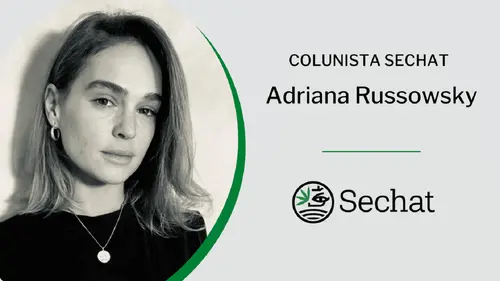
By Adriana Russowsky
The Brazilian society is beginning to ride a wave of greater collective awareness and re-pleasure, recognizing and claiming ancestral practices as medicine. Cannabis emerges as a protagonist in this new era of understanding, freedom, and repatriation. Along with mushrooms, it brings a new color to the already known green-yellow, with combinations of purple and other unexpected shades from the plant's trichomes.
Indeed, consumers are more informed, demanding, and claim freedom through medicine. While business initiatives try to build concepts and ground, they create tricks and are on the lookout for decisions, amidst a carousel of mistakes and successes, it is up to the citizen to become demanding of principles and access possibilities, understanding shared value: the emergence of a different reality.
Bioinspiration (observation of nature) can be a new awareness for the perception - largely mistaken - already established. It can also guide robotics that is close to being politically correct and committed to predicting a less chaotic future.
With eyes turned to new artificial intelligence as advisory and communication, the level of demand increases. If we do not talk about economic restriction, the search for shared value of better products and solutions will become increasingly real and present, a desire of the consumer. The social issue comes into play, inspired by music and the empowerment of a counterculture that strengthens the need of a corrupted society.
Nationally, tables and opinions are being called, with experts who will be responsible for what will be instituted. Politicians try to rise with the flag. Since we have taken so long, there are issues that must be reconsidered to create values in a new era, and there is no better way to start than through the governmental voice. A deep and realistic review of how the consumption chain affects the health of the population and the environment must be conducted. Care must be taken so that the citizen does not accept certain victories as a way to alienate themselves from other issues.
With awareness of the standards to which the world has submitted, universal values should perhaps underpin the new guidelines with the aim of building and uniting for a better future. And this should do justice to all forms of production. Undoubtedly, transparency and listening should be administered by rulers as a strategy. In addition to a complete reconfiguration of social structuring regarding the perception and progress of crime in Brazilian territory.
New concepts, species, and overcoming standards
The ancestral practices that have emerged from the obscurity of empiricism are still considered “modern” or “alternative” in cultural language. They claim community and individual progress following human and environmental precepts. Occupying the “hype” space of the media and entering the minds of citizens.
After all, how much is the barcode on each person's face worth?
Who is controlling them?
This story revives the collective instinct for freedom of expression and the rights of living beings. The methodology employed by the pharmaceutical industry during the industrial revolution, gaining strength in times of war, brings a similar reference to the "Animal Farm": domination, control, and stimulation of consumption.
It used the same weapon with which it is now hurt: the advertising and information that circulate diversified and freely through the internet, giving intensity to the democratic cry.
Just like humans, plants experience changes in their genome through epigenetics. All the time, day by day, with what they come into contact with: food, medicines, chemical agents, pesticides, or simply, the air. The quality of the products used as health therapies must therefore be prioritized, as they are herbs that will likely be part of our body's routine, in deep contact. They have had and continue to have sufficient genetic alterations, in a case of symbiotic survival with humans. Better products, better certifications, space for a new economy that generates jobs in a sustainable place. The only ones who are seeing this so far are other countries. It is time to encourage national production correctly, enabling it to make sales to the international market.
Regarding planting, let it be as correct as possible, and why not, through a beautiful historical repatriation?
If the utopia of a better society remains as it is conceived, distant, why not use a dystopian thought to evolve society as a whole?
If we think about medicinal oil, why not prioritize full spectrum oils instead of synthetic ones?
Re-signifying the production chain and the job generation system, encouraging research and obtaining cannabinoids from plants other than cannabis and breaking the logic. True progress will be based much more on the answers and benefits than on purchased certificates issued by big players. If pesticides or chemicals generate autism and depression, we cannot conduct treatments with oils that had their raw material cultivated in the same way. Green flags (and today costly) amidst a cold war.
While beautiful red poppy gardens are prohibited, militarized coca plantations populate countries where the mafia has more power than the state, small coffees are the affection served by large corporate offices, and the distilled and fermented industry maintains its solidity. Indigenous cultures fight for an ideological space through cacti, vines, and herbs – while they submit to bad agreements and a social showcase (what would be the other option, after all?). Fungi and mushrooms grow in boxes with controlled temperatures and half-light, attracting the attention of patients, professionals, and students in the health field. And specialized chocolatiers.
But we still see boxes of Venvase on the curbs of the streets, and the ridiculously named Concerta devouring potential creative minds amidst a looping - of consumption patterns and corporate dictatorship. Amidst the irony of the new and the old, how to raise and organize patterns that were once toppled and reintegrate them into society? Culture and information reconfigure and solidify pillars.
About the author:
Adriana Russowsky is a pharmacist, senior phytotherapist, and master in Rehabilitation Sciences. A pioneer in the cannabis field in the country, she works on projects for the creation and direction of Research and Development of Products and Services in the field of Cosmetology and Natural Medicines.
Today she composes and implements the strategies of the protocols she developed and created, within cannabis commercialization companies and cannabis clinics in the country, and believes that scientific and educational institutions should better inform future doctors and other professionals about this need for knowledge, expanding what she believes is the correct access to the community.