From molecule to market: Chemistry drives the cosmetics industry
At in-cosmetics Latin America 2026, the CFQ/CRQs System highlights Chemistry in cosmetics innovation, safety, and stability. Read on Sechat


During the in-cosmetics Latin America 2026 trade show, the CFQ/CRQs System highlighted the strategic importance of Chemical science in advancing the personal care, perfumery, and cosmetics industry.
During its participation in the event, the regulatory agency emphasized how the work of professionals in the field is crucial both in creating new technologies and in ensuring the safety, efficacy, and stability of cosmetics and fragrances, from development to the final consumer.
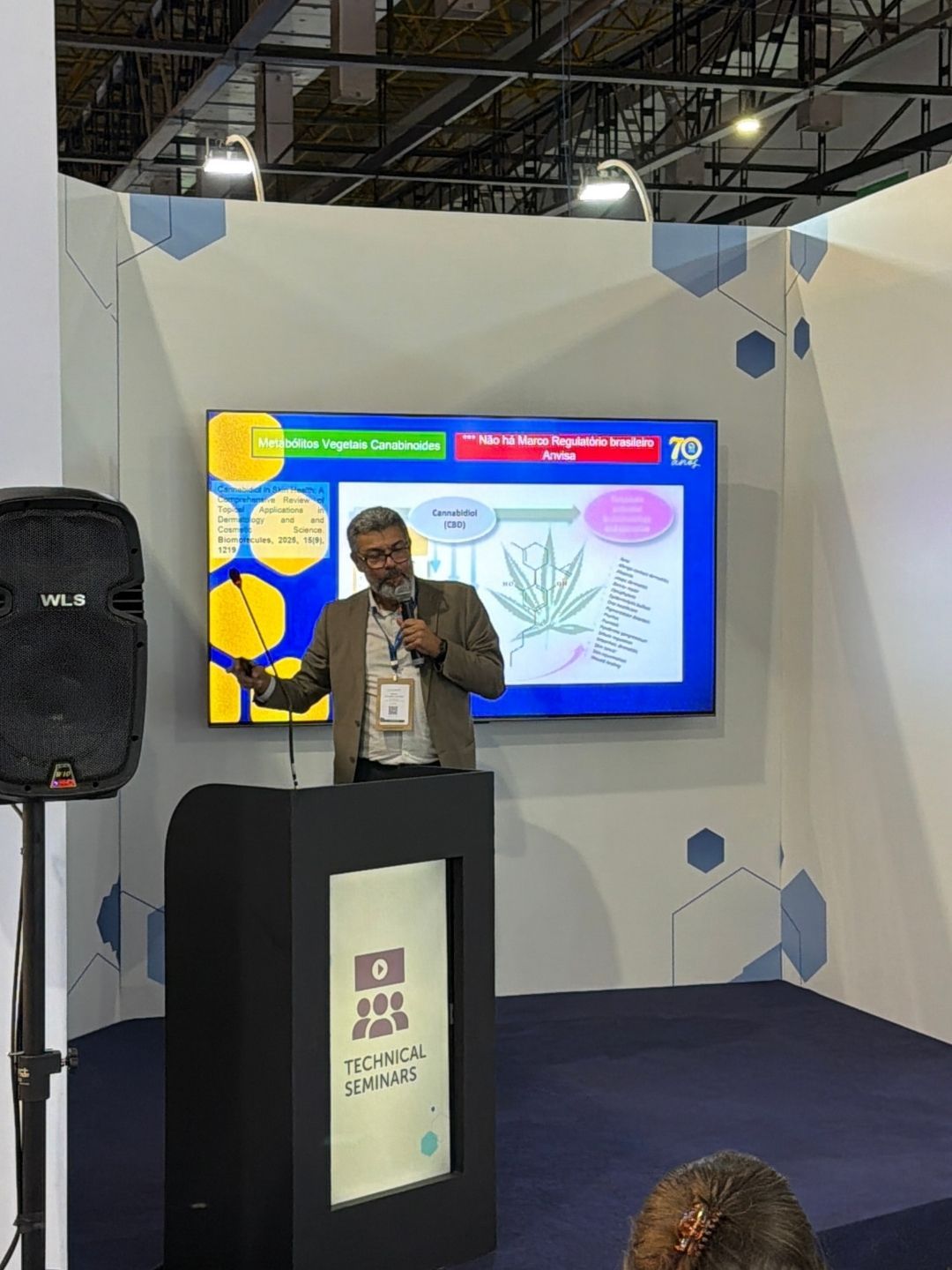
He also pointed out that, while the use of cannabinoid derivatives for therapeutic and medicinal purposes is already a regulated and rapidly expanding reality in the country, the cosmetics sector requires a highly strategic approach grounded in scientific advancement.
Presenting data from recent studies on the application of Cannabidiol (CBD) in dermatology, the board member noted that the path to innovation in cosmetology involves a clear understanding of the molecule's biological effects on the skin—such as its antioxidant, anti-inflammatory, analgesic, and skin barrier-repairing properties—in contrast to the current national regulatory landscape.
"While in the pharmaceutical and therapeutic sectors cannabis has already established itself as a reality for Brazilian patients, the strategy for cosmetics must be anchored in rigorous scientific knowledge and the construction of an appropriate regulatory framework. Scientific literature demonstrates enormous potential for Cannabidiol in skin health, ranging from controlling oiliness and inflammation to providing support in conditions such as acne and dermatitis. However, the major strategic step for the personal care industry to innovate safely and with quality in Brazil relies directly on Anvisa consolidating a specific regulatory framework for cosmetic products. Analytical chemistry and the standardization of phyto-ingredients are the foundation for transforming this scientific promise into high-performance products for society," stated Dr. Ubiracir Fernandes Lima.
Chemical science and formulation stability
Federal board member Dr. Ubiracir Fernandes Lima mentioned that, beyond developing new formulas and substances, the market must also ensure that these products have the stability to withstand Brazil's climatic conditions.
"Our role as the CFQ/CRQs System was to show that this science exists behind the scenes to predict and monitor the behavior of developed substances. We need to create systems within formulations to predict interactions with light, humidity, and oxygen, ensuring that product innovation and quality remain intact until the expiration date," the board member explained.
These and other topics were addressed by Ubiracir during his lecture "From molecule to formulation: how chemical science helps generate new technologies" at the event.
According to the speaker, the industry as a whole, from professionals to consumers, now sees scientific rigor as a path toward best practices and innovation, and the CFQ is an ally in ensuring that rigor.
"The public and professionals are increasingly understanding that Chemical science is an indispensable ally for innovation, and that the CFQ/CRQs System works alongside industry and for the protection of society," added Ubiracir.
Basic research and the production chain
The importance of basic research, or "bench science," throughout the entire sector's production chain was another key highlight of Ubiracir's talk.
"If I don't have safety, efficacy, and stability data for the proposed formulation, the product cannot be regularized. And if it isn't regularized, it doesn't reach the market. From here, at my bench, I can help the professional further down the line who keeps the company afloat. It's a chain; we're all in this together," said the board member.
For the specialist, innovation cannot come at any cost; the sector must also adhere to sanitary and health regulations.
"It's useless to have the most beautiful or most effective product if it doesn't comply with sanitary regulations. The big challenge in innovation is understanding how molecular structures determine chemical interactions and how formulation controls stability and safety all the way to the end user," he explained.
Finally, Ubiracir emphasized that Chemical science is the solution, not a barrier to the market.
"Chemical science is the solution. It only becomes a problem when poorly applied or used without proper technical care. At the CFQ/CRQs System, we work to provide support, training, and security so that both the industry and professionals operate correctly and within regulatory standards."
The market perspective: safety and olfactory creation
The relevance of technical control and professional licensing is evident in the daily operations of companies in the sector.
At the event, pharmacist and chemical technician Larissa Soares, who works as a fragrance evaluator in the market, explained how Chemistry is key to developing new scents and ensuring product safety for the end consumer.
"Fragrances are entirely linked to chemistry, both through the study of molecules and through the olfactory architecture of top, heart, and base notes. Chemistry is essential to ensure which raw materials can be used and to ensure compliance with regulations to prevent allergenic components," the professional noted.
Larissa also stressed the importance of companies in the sector employing professionals who are properly registered and monitored by the Regional Chemistry Councils, ensuring technical backing at every stage of production.
Letícia Dias, a graduate of the Universidade Federal de São Carlos (UFSCar) and a researcher in Computational Chemistry in cosmetics, commented that the intersection between science and the market is what drives the industry forward.
"The cosmetics market gains tremendously when we unite consumer perspectives with applied chemical science. Seeing booths explaining the chemistry behind each benefit, rather than just the sensory aspect, shows how innovation and scientific research are vital to the sector," highlighted Letícia.
For the researcher, although the sector's main consumer base is predominantly female, empowering women in academic research and scientific development must continue to be actively encouraged.
"We still need greater visibility for women in science and research. In the cosmetics sector, women have been predominant precisely because they understand the product both as consumers and as scientists. We know what consumers are looking for, and we have a lot to contribute to the sector's development and innovation," concluded Letícia.
Photo credit: Assessoria de Comunicação/CFQ