Hemp as the new powerhouse of Brazilian agribusiness
Hemp emerges as a sustainable alternative in Brazilian agribusiness, with applications spanning from industry to healthcare.
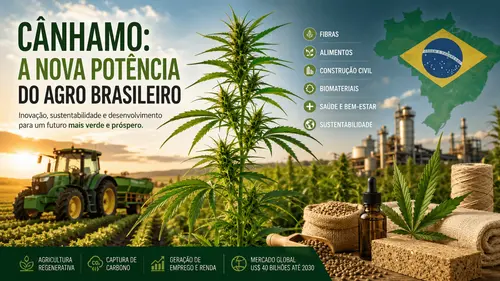
By Robson Rizzon - CEO - Plantmanager
Hemp is not a distant promise. It is a real opportunity, but it still depends on three breakthroughs: clear regulation, tropical agronomic research, and production infrastructure.
Brazil has unique conditions to become a global leader: agricultural scale, climate, soil, on-farm technology, logistics chains, growers accustomed to commodities, and a proven track record of turning complex crops into global leadership.
When we look at the international landscape, it becomes clear that this is not an experimental market. According to consulting firm Grand View Research, the global industrial hemp market is expected to surpass US$ 40 billion by 2030, driven by applications in fibers, food, construction, biomaterials, and pharmaceuticals.
Comparing it to soybeans is not an exaggeration as a narrative of potential. Soybeans were not born a giant in Brazil either. The crop required research, adapted genetics, credit, scale, market development, and public policy. Hemp is at an earlier stage of that same journey.
The soybean analogy
Soybeans were once seen as a crop of little relevance in Brazil. For decades, their adaptation was limited, especially outside the South. The turning point came when science, Embrapa, genetic improvement, soil correction, and tropical technology enabled expansion into the Cerrado.
Today, soybeans account for approximately US$ 53 billion in annual Brazilian exports, according to data from the Ministry of Agriculture and the Foreign Trade Secretariat (Secex) for 2025.
Hemp is experiencing something similar: the market exists, industrial and medicinal uses exist, but there is still a need to turn potential into an organized supply chain.
The parallels are clear:
● genetic adaptation to the Brazilian climate;
● establishment of technical protocols;
● development of an industrial supply chain;
● formation of an off-taker market;
● regulatory certainty;
● the ability to trace, standardize, and scale.
For hemp to stop being a niche, it must move away from the framing of a controversial plant and enter the logic of a strategic raw material. And that is precisely what we at PlantManager, the first hemp-first startup, are setting out to lead in Brazil.
The window of opportunity is open right now. While Brazil is still structuring its regulations, countries such as China, France, Canada, and the United States already have well-established supply chains.
The question is not whether there will be a market. The market already exists. The question is who will capture this wealth.

Economic potential and impact on agribusiness
Hemp can simultaneously impact several productive supply chains:
● textile fibers;
● bioplastics;
● pulp and paper;
● construction;
● food and oils;
● cosmetics;
● pharmaceuticals;
● biomaterials;
● carbon credits;
● regenerative agriculture.
What makes hemp so significant is not just its agricultural yield, but its ability to serve multiple markets at the same time.
While soybeans primarily produce protein, oil, and meal, hemp can supply raw materials to dozens of different economic sectors.
According to the Food and Agriculture Organization of the United Nations (FAO), hemp is one of the most versatile crops in the world, with the potential to yield more than 25,000 different products, including food, fibers, building materials, bioplastics, cosmetics, paper, pharmaceuticals, and industrial inputs.
For this reason, several countries view hemp not merely as an agricultural crop, but as an industrial platform.
China, for example, has become the world leader in hemp fiber production and dominates much of the global textile supply chain associated with the crop.
France has built one of the largest European supply chains, channeling production toward biomaterials, sustainable construction, and higher-value industrial applications.
Canada has developed an industry focused on seeds, plant proteins, and functional foods.
Meanwhile, the United States, following the passage of the 2018 Farm Bill, turned hemp into a new economic frontier, attracting billions of dollars in investments for genetics, industrial processing, research, and new product development.
This is a major distinction when compared to many traditional crops.
When we talk about soybeans, corn, or cotton, we usually think of specific supply chains.
When we talk about hemp, we are talking about a raw material capable of simultaneously supplying the food, healthcare, construction, textile, paper, biotechnology, energy, and sustainability sectors.
Therefore, the economic impact does not end in the field.
It extends across the entire industrial transformation chain, driving demand for:
● processing;
● certification;
● traceability;
● laboratories;
● logistics;
● technical assistance;
● research;
● manufacturing.
This characteristic multiplies job and income generation throughout the production chain.
For Brazil, hemp also represents an opportunity for agricultural diversification.
Rather than competing with well-established crops, it can complement existing production systems and unlock opportunities in new, high-value markets.
If the country builds a sound regulatory framework, invests in tropical research, and structures its production chain, it could take part in a global market estimated at over US$ 40 billion by 2030, according to Grand View Research.
The central point is that hemp should not be seen merely as a new agricultural crop.
It should be seen as a new industry.
Technology and viability
Global technologies already exist to cultivate, process, and trace hemp.
China is currently the world's largest producer of hemp fibers, accounting for more than 50% of global natural fiber production, according to data compiled by the FAO and the international natural fiber industry.
France accounts for 60% to 70% of European hemp production, according to the European Commission, serving as a benchmark for industrial applications in construction, technical paper, and biomaterials.
Brazil's challenge is not inventing the technology. It is tropicalizing the technology.
It is not enough to import seeds, machinery, or protocols. Genetics, management, plant density, crop cycle, harvesting, drying, and traceability must be adapted to Brazilian conditions.
Brazilian growers would not need to reinvent their entire infrastructure, but they would need to operate within a more controlled and traceable model.
Regulation and infrastructure
Brazil must establish clear regulations to separate industrial hemp from adult-use cannabis.
The rest of the world proves this is possible.
Canada regulated commercial hemp cultivation back in the 1990s and has recorded, in certain recent crop cycles, more than 50,000 licensed hectares for production, according to the Canadian government's official Industrial Hemp Program.
In the United States, following the passage of the 2018 Farm Bill, the market for hemp-derived products grew to generate billions of dollars annually, according to reports from the USDA and the Hemp Industries Association.
The main hurdles in Brazil today are:
● legal uncertainty;
● the absence of a comprehensive regulatory framework;
● lack of registered cultivars;
● seed regulations;
● laboratory control;
● traceability;
● enforcement and inspection;
● licensing.
Without these, Brazil risks repeating a historical mistake: importing technology that it could develop domestically.
PlantManager as a frontrunner
PlantManager was born from the vision that Brazil must prepare for a new regulated, technology-driven, and traceable agricultural supply chain.
Being a hemp-first startup means looking at hemp not as a trend, but as a core strategy.
While several countries are building production infrastructure, PlantManager is working to build the digital infrastructure for this new supply chain.
Our operations focus on management, traceability, compliance, and operational intelligence.
We believe that the sector's success will depend not only on planting, but on controlling, monitoring, documenting, and proving quality at every stage of the operation.
Solutions for agribusiness
PlantManager supports growers from planning through operational management.
In practice, we organize:
● land parcel registration;
● crop season planning;
● batch management;
● crop monitoring;
● regulatory documentation;
● traceability;
● yield indicators;
● regulatory compliance.
Our goal is to turn a complex operation into an auditable, predictable, and scalable one.
What modern agriculture did for soybeans over the past decades, we believe management technology will do for hemp in the coming years.
Solutions for patient associations
Associations play a fundamental role in developing the Brazilian supply chain.
Today, they represent one of the main pathways for patients to access cannabis-derived products.
According to data from Anvisa and the Brazilian association sector, tens of thousands of patients are already served by authorized or court-sanctioned associations to access cannabis-based treatments.
PlantManager helps these organizations structure:
● traceability;
● document control;
● patient management;
● production management;
● compliance;
● accountability and reporting.
The better organized an operation is, the greater its legal, operational, and institutional security.
Technology ceases to be a differentiator and becomes a requirement.
Future and market outlook
Over the next 5 to 10 years, we believe hemp will cease to be seen solely through a medicinal lens and will come to be recognized as a comprehensive agro-industrial supply chain.
The European Commission reports that the cultivated hemp area in the European Union grew from 20,540 hectares in 2015 to 33,020 hectares in 2022—an increase of more than 60% in just seven years.
Over the same period, European production rose from 97,130 metric tons to 179,020 metric tons, according to official European Union data.
This shows that growth is happening not only in North America, but also in highly regulated markets.
Brazil has the potential to become a major exporter because it brings together three rare advantages:
● land availability;
● favorable climate;
● agricultural excellence.
With regulatory certainty, research, and investment, we can participate in a global market estimated at more than US$ 40 billion by 2030, according to Grand View Research.
The starting point will be the combination of clear regulation, tropical research, and the construction of a domestic production chain.
Hemp could be the next major revolution in Brazilian agribusiness because it combines three forces that have already turned soybeans into a global powerhouse: land, science, and scale.
The difference is that we are now talking about a crop capable of simultaneously supplying the food, healthcare, construction, manufacturing, biotechnology, and sustainability sectors.
According to the FAO, few agricultural crops have the potential to generate more than 25,000 different commercial applications.
If Brazil gets it right now, we will not just be creating a new agricultural crop.
We will be building a new domestic industry.
Sources
● FAO – Hemp: Nature-Based Solution for Sustainable Agriculture
● Embrapa – Research on Cannabis and Industrial Hemp
● European Commission – Hemp Production in the European Union
● Health Canada – Industrial Hemp Program
● USDA – Hemp Production and Market Reports
● Grand View Research – Industrial Hemp Market Analysis
● Fortune Business Insights – Global Industrial Hemp Market Report