In 'Cannabis Global Co.', Paulo Pereira reflects on the challenges and complexities of the cannabis market
Paulo Pereira launches Cannabis Global Co., a book that analyzes cannabis capitalism and the contradictions of cannabis legalization worldwide

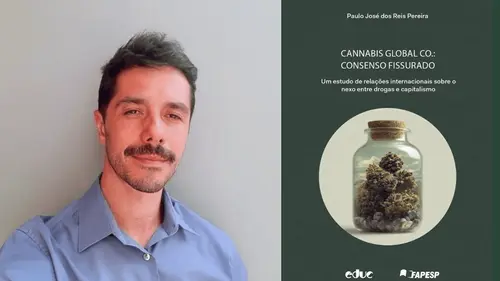
This Saturday, October 18th, at 3 pm, Livraria Tapera Taperá (SP) will host the launch of the new book by researcher and author Paulo Pereira: “Cannabis Global Co.: fractured consensus – An International Relations study on the nexus between drugs and capitalism” (EDUC, with support from FAPESP).
The event will feature historian Henrique Carneiro, who wrote the preface and will participate as a commentator in the conversation. The book, a result of over 15 years of research on drug policy, analyzes the phenomenon that Pereira defines as “cannabis capitalism”, the transition from prohibition to the commodification of the plant, now transformed into a global asset under neoliberal logics.
Next, the author discusses the central concept of the work, the contradictions of the legal cannabis market, and possible paths towards a fairer and more sovereign drug policy in Latin America.
Interview | Paulo Pereira
1. Your book proposes the concept of “cannabis capitalism”. How do you see the paradox between the legalization and commodification of cannabis?
The concept of “cannabis capitalism” that I develop in the book attempts to address the paradox you identify. The legalization of cannabis, in many contexts, did not result in a rupture with the prohibitionist logic, but rather in its reconfiguration under new forms of control and accumulation.
In broad terms, it is possible to say that the same structure that previously criminalized now repositions itself to profit from the new legal cannabis commodity. Thus, it is a transition from prohibition to commodification. The plant ceases to be seen as a threat to be transformed into an asset, product, and instrument of profitability.
However, inequality and structural racism persist and, in many cases, deepen. Populations that were historically criminalized continue to be excluded from the benefits of legalization. As the saying goes, everything changes to remain the same.
2. After 15 years of research, what were the most revealing moments or data about the relationship between global capitalism and the cannabis market?
Throughout this time, what struck me the most was realizing how global capitalism managed to transform a once marginal object, cannabis, into one of the most emblematic laboratories of neoliberal experimentation.
I identify three relevant moments in this process. The first was the financialization of cannabis, which turned the plant into a speculative asset. Transnational corporations listed on stock exchanges began to be valued in billion-dollar figures, often detached from real production. This paved the way for mergers, acquisitions, and the dominance of a few groups over the entire global chain, companies like Canopy Growth, Tilray, Aurora, and Cronos Group are examples. The 2018 crisis, which I analyze in the book, is a direct result of this dynamic.
The second moment involves the role of state regulation. Legalization did not come with democratization. Regulatory frameworks favored companies with capital, infrastructure, and political lobbying. In this context, the discourse of “safety” and “pharmaceutical quality” served as language that legitimizes corporate control.
Finally, the third point was realizing how the discourse of health and innovation became central to justify this appropriation. Medicine and biotechnology were mobilized to “purify” cannabis, erasing its traditional, community, and spiritual uses.
In my assessment, all of this shows that cannabis has been conceived as a civilizational project, a way to expand colonial and neoliberal logic under the pretext of modernization.
3. The book's subtitle mentions a “fractured consensus”. What fractures do you identify today in the dominant discourse on cannabis and where is there still room for resistance and narrative reconstruction?
When I speak of a “fractured consensus”, I refer to two complementary movements. The first is the fracture of the prohibitionist consensus, the so-called “Vienna consensus”, an international arrangement that supported the global prohibition of cannabis under the idea of health and safety, based on the UN conventions of 1961, 1971, and 1988.
This consensus began to erode as countries and social movements began to question its effectiveness and legitimacy. Advances in legislation on adult use, medicinal access, and the debate on the ineffectiveness of the “war on drugs” opened gaps in this system.
The second fracture is not about the drug itself, but about the money it began to move. The transformation of cannabis into a commodity created a new consensus around profit. Governments and corporations work together to seize the economic opportunities opened by legalization, taxes, investments, new markets.
But structural inequalities remain. The convergence between cannabis companies and the tobacco, pharmaceutical, and alcohol industries well expresses this logic.
“Cannabis Global Co.” thus represents a consensus fractured by profit, coexisting with the contradictions of global capitalism and the racist and colonial legacies of drug control.
4. How does Latin America, with its history of criminalization and inequality, fit into this global cannabis scenario? Are there possible paths towards a fairer and more sovereign drug policy in the region?
Latin America occupies an ambiguous position in this new global scenario. On the one hand, it carries a violent history of repression and criminalization; the region was indeed a laboratory of prohibitionism, which fell on Black, Indigenous, and poor bodies.
On the other hand, it is also a fertile space for resistance and political innovation.
Social movements, patient associations, and cultivators challenge the boundaries imposed by illegality and build practices that point to alternative models of regulation.
These experiences open up space to imagine a fairer drug policy, based on historical reparation and sovereignty. A policy capable of addressing both the legacy of prohibitionism and the corporate capture of legal markets. Only the future will tell which of these forces will prevail.
Service
Book launch “Cannabis Global Co.: fractured consensus – An International Relations study on the nexus between drugs and capitalism”
When: Saturday, October 18th, at 3 pm
Where: Livraria Tapera Taperá – São Paulo (SP)
Featuring Henrique Carneiro (historian and author of the preface)