Medical cannabis: US suppliers represent 72% of mapped supply in Brazil
Discover how sanitary regulations and CBD costs affect the sector. Learn all about the future of medical cannabis at Cannabis Connection 2026.


Product costs, supply chain structure, and market entry rules are among the issues gaining prominence for companies interested in medical cannabis in Brazil. The variety of formulations available for individual import and the differences in cost per milligram of CBD help outline this landscape, while regulation and commercial operational infrastructure remain at the core of business decisions.
Data from a survey of the product list linked to RDC 660/2022 from the National Health Surveillance Agency (Anvisa) points to more than 350 brands and products from different regions of the world. Meanwhile, information from the portfolio of Cannect shows that the average cost per milligram of CBD varies depending on the concentration analyzed. At Cannabis Connection 2026, Allan Paiotti, CEO of Cannect, will provide an in-depth analysis featuring new perspectives on the overall market landscape.
These findings do not represent, on their own, the full size or complete dynamics of the Brazilian market. Together, however, they help raise relevant questions for industry stakeholders: how to evaluate products and suppliers, understand costs, and identify opportunities within applicable regulations?
These questions will be among the themes of Cannabis Connection 2026, an event hosted by Sechat on November 5 in São Paulo, bringing together representatives from diverse sectors to discuss data, regulation, and business outlooks in medical cannabis.
Being at Cannabis Connection means being close to those who are building the future of the medical cannabis market
X-ray of the medical cannabis product supply
An analysis of the list linked to RDC 660/2022 shows a predominance of oral oils and solutions, but also identifies capsules, topical products, and other delivery forms.
The percentages below are estimates based on the analyzed list, not a representation of each category's overall share across the entire Brazilian market.
| Indicator | Estimate from analyzed list |
|---|---|
| Brands and products | More than 350 |
| Oral oils and drops | About 80% |
| Capsules and softgels | About 12% |
| Topical and transdermal products | About 4% |
| Special formulations and other delivery forms | About 4% |
| Reported CBD concentrations | From 300 mg to 24,000 mg |
| Bottle volume | From 10 ml to 120 ml |
In addition to oils and drops, the list includes capsules, gels, ointments, sprays, suppositories, formulations using technologies such as nanoemulsions, and products featuring other cannabinoids like CBG and CBN.
For businesses, the variety of delivery forms represents a starting point for assessing portfolios, suppliers, and product positioning. However, CBD concentration should not be used in isolation to compare end-consumer prices, quality, or clinical outcomes: additional information regarding composition, presentation, and individual product specifications is required.
Cost per milligram of CBD: what the Cannect data reveals
Data provided by Cannect shows the average cost per milligram of CBD across its portfolio for three concentrations. The numbers indicate a decrease in the average cost per milligram as the concentration increases.
| CBD concentration | Reported average cost per mg |
|---|---|
| 1,500 mg | R$ 0.20833 |
| 3,000 mg | R$ 0.14167 |
| 6,000 mg | R$ 0.09734 |
Source: data provided by Cannect, regarding the average cost per milligram of CBD in its portfolio.
In the comparison presented, the average cost per milligram at the 6,000 mg concentration is approximately 53% lower than that reported for the 1,500 mg concentration. The calculation is based exclusively on the figures supplied by the company.
This comparison does not imply that the higher concentration product necessarily has the lowest final retail price or is the most suitable option in every scenario. Cost per milligram is a specific metric that must be evaluated alongside other factors, such as volume, composition, presentation, and total price.
The data should also not be interpreted as an average price across the entire Brazilian market. They reflect Cannect's portfolio and offer a cross-section to examine cost structuring in a category with varied concentrations and delivery formats.
For businesses, understanding these differences is crucial for both portfolio assessment and commercial positioning analysis. Cost comparison, however, is only one part of the equation: import requirements, sanitary compliance, and commercialization regulations also shape company operations.
International suppliers expand supply chain scope
The estimated geographic breakdown of suppliers identified in the analyzed list points to a predominance of US companies, followed by suppliers from Latin America and Europe.
| Suppliers' region of origin | Estimated share |
|---|---|
| United States | About 72% |
| Latin America | About 14% |
| Europe | About 11% |
| Asia, Africa, and Oceania | About 3% |
Among the companies listed are Neurogan, Charlotte’s Web, Green Roads, CBDfx, and CV Sciences from the United States; Levendis SAS, Netcann Pharma, and Fotmer from Uruguay; and Colombian companies such as Clever Leaves and Avicanna. The list also includes European, Israeli, Australian, and African suppliers.
These percentages are estimates based on the examined list, not market share data, revenue, or actual imported volume by country. The presence of a brand on the list also does not mean it holds an equivalent commercial market share in Brazil.
Even so, this overview highlights the international scale of suppliers operating through the exceptional individual import mechanism. For Brazilian companies, this scenario brings supply chain organization, commercial relationships, and the operational infrastructure needed to connect cross-border markets to the forefront.
Regulation: understanding access pathways is essential
The list associated with RDC 660/2022 is tied to the exceptional import process by individuals for personal health treatment, subject to prescription by a qualified professional and registration with Anvisa.
This pathway is not equivalent to sanitary product registration or a broad commercial authorization in Brazil. Therefore, the diversity of brands and presentations on this list should not be confused with the lineup of products authorized for retail pharmacy sales.
In 2026, Anvisa also updated the regulatory framework for cannabis products intended for human medicinal use through RDC 1.015/2026, which replaced RDC 327/2019 and came into effect on May 4.
For businesses evaluating opportunities in the sector, understanding the differences between access models and the requirements applicable to each operational activity is an essential part of feasibility analysis. Identifying market demand or a product is not sufficient on its own to determine how an operation can be structured.
Regulation, therefore, is not merely a legal topic: it directly shapes decisions regarding portfolio, sourcing, manufacturing, importation, and commercialization.
Payments and operations are also key parts of the business chain
Beyond products and health regulations, the market's development depends on the infrastructure needed to connect companies and enable their operations. Payment methods are a core part of this discussion, especially within a supply chain involving domestic and international commercial relationships.

This is one of the key perspectives WEpayments is bringing to Cannabis Connection 2026. Fernanda Zago, CEO and co-founder of the company, highlights the opportunity to understand the needs of companies operating in the sector.
“For WEpayments, it is a valuable opportunity to understand the sector's needs and reinforce the strategic role of payment solutions in connecting businesses, enabling domestic and international operations, and driving sustainable growth in the medical cannabis market,” says Zago.
The executive also associates participating in the event with building closer ties to companies and professionals monitoring market developments.
“Being at Cannabis Connection means being close to those who are building the future of the medical cannabis market, understanding their challenges, and matching opportunities with payment solutions that enable industry growth in Brazil and globally,” she points out.
The discussion broadens the business perspective beyond product offerings. In a segment involving international suppliers and diverse regulatory demands, understanding companies' operational requirements is also critical to building growth strategies.
Cannabis Connection 2026 gathers diverse market perspectives
Data on formulations, costs, and supplier origins helps quantify aspects of the supply chain, but does not provide standalone answers for business decision-making. Evaluating opportunities requires cross-referencing this information with regulation, commercial dynamics, and the operational requirements necessary to navigate the industry.
Cannabis Connection 2026 will take place on November 5, starting at 2:00 PM, at Edifício JK 1600, in Itaim Bibi, São Paulo. Organized by Sechat, the event reaches its fourth edition aiming to convene professionals and companies to discuss data, regulation, and business outlooks in medical cannabis.
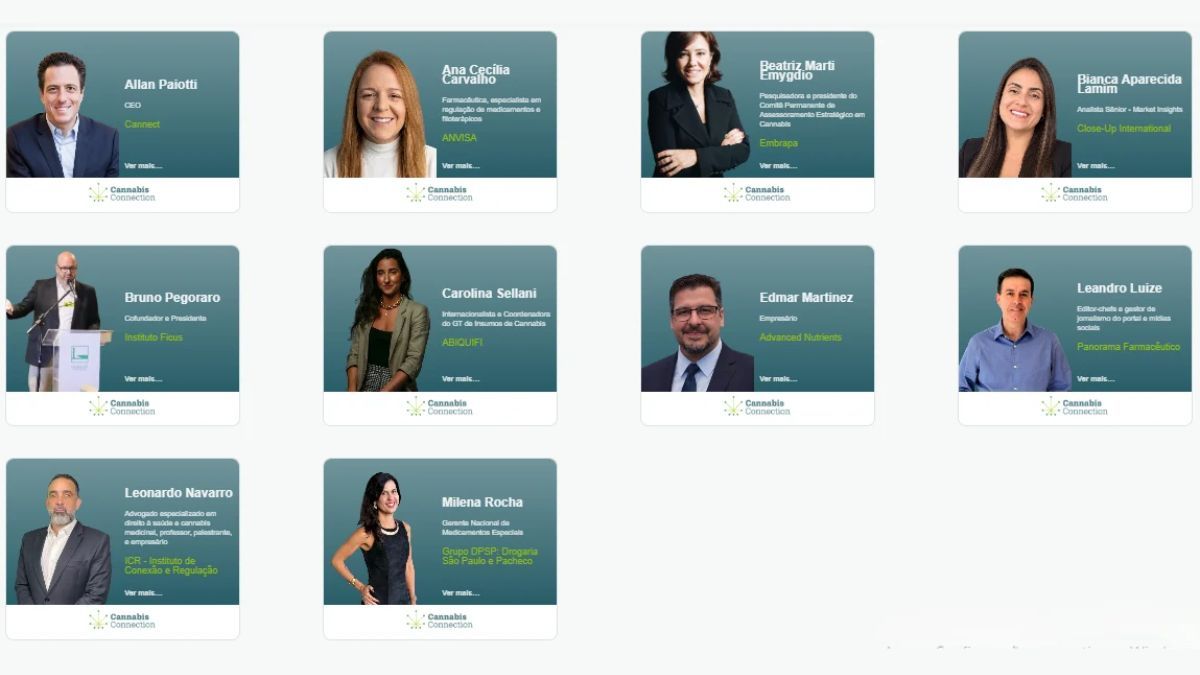
Confirmed attendees include Allan Paiotti, CEO of Cannect; Ana Cecília Carvalho, Anvisa specialist in medicine and herbal product regulation; Beatriz Marti Emygdio, researcher at Embrapa; Carolina Sellani, from ABIQUIFI's raw materials working group; Bianca Aparecida Lamim, from Close-Up Market Insights; Leandro Luize, from Panorama Farmacêutico; Leonardo Navarro, from ICR; Bruno Pegoraro, from Instituto Ficus; and Edmar Martinez, from Advanced Nutrients.
The program also features Daniel Jordão, CEO of Sechat, and Dr. Pedro Pierro, scientific director of the platform. The presence of professionals from multiple sectors enables dialogue on issues spanning the entire supply chain, from regulation and research to market dynamics and enterprise operations.
For business owners already operating in medical cannabis, professionals tracking regulatory updates, and entrepreneurs evaluating entry into the sector, the event provides an opportunity to deepen understanding of current challenges and emerging market possibilities.
How can market developments be translated into sounder business decisions? This is one of the core questions bridging product and cost data with discussions on regulation, sourcing, and operational business infrastructure.
Cannabis Connection 2026 will offer a forum to follow this debate up close, exchange perspectives with industry professionals, and discuss pathways for developing the Brazilian market.
Secure your spot: https://cannabisconnection.com.br/