Paralympic Athletes Reveal Positive Lifestyle Changes with Cannabis Use
Talisson Glock and Susana Schnarndorf share how Cannabis has been important in their lives and sports
By Kim Belluco
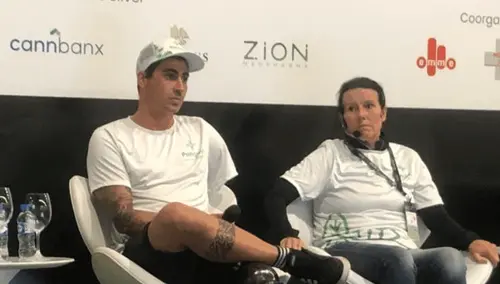
A panel discussion featuring Paralympic athletes Talisson Glock and Susana Schnarndorf concluded the second day of the Medicinal Cannabis Congress held at Expo Center Norte. Also participating in the conversation were psychiatrist Dr. Pietro Vanni, health promotion specialist Dr. Paula Dall’Stella, orthopedist Dr. Ricardo Ferreira, and facilitator Dr. Jimmy Fardin Rocha.
The athletes gave impactful testimonies about their lives and shared how Cannabis helped them find relief from both physical and emotional pain. Both were present at the last Paralympic Games.
Eighth in the 150m medley S4, swimmer Susana Schnarndorf, 53, was diagnosed in 2005 with Shy-Drager Syndrome, a degenerative disease known as Multiple System Atrophy (MSA), which primarily affects vital organs such as the heart and lungs. This led her to transition from triathlon to swimming, where she had to relearn even basic movements but never gave up and became a Paralympic medalist.
“Sports saved me. I have less than 40% of lung capacity. It's a daily struggle against my body. But I don't dwell on it. I set my sights on the competitions ahead,” said Susana before discussing Cannabis. “Cannabis gives me a quality of life that I didn't have before with traditional methods. Being able to feel less pain, sleep well, focus solely on something, these are things that make a difference.”
Talisson Glock, on the other hand, suffered a train accident at nine years old. He was hit by a train near his school in Joinville, resulting in the amputation of his left leg and arm. He started swimming and quickly excelled. Today, he has five Olympic medals, including a gold one from Tokyo.
"I started swimming to rehabilitate and in Tokyo, I was able to win my first gold medal, which is a pride for any athlete," explained Talisson, who also mentioned the importance of Cannabis. "I always knew about CBD, but we couldn't find it. Years later, I was able to use it for the first time in a competition (at the last Paralympics). The improvement is immediate. But the long-term improvement is the most significant. In my view, it has greatly improved my sleep and anxiety. And that helps in other aspects as well."
Talisson provided more details on the use. "The effect of the cream is better, regardless of the sport. I use it when I wake up and before going to sleep. Also when the training is more intense. We feel a decrease in pain and are more ready for the next training session. But it's important to remember, it doesn't solve everything on its own. I do physiotherapy, work on injury prevention. It alone doesn't solve everything, but it makes a difference. We feel better in various aspects," he concluded.
DEEPENING CANNABIS USE
Jimmy Fardin Rocha provided more details on Cannabis use in sports. "We have evidence that THC is not good before a competition. It's much better during and after because it can alter the athlete's performance and send blood to places it doesn't need to go, which isn't ideal. It's more convenient during the activity as the athlete can focus better, especially in, for example, a marathon. However, caution is needed as the athlete may forget about the pain and end up injuring the muscle. That's why it's prohibited in competitions, unlike CBD, which doesn't alter the athlete's performance and greatly helps in pain management and athlete recovery."

Psychiatrist Pietro Vanni highlighted the athlete's daily struggle with pain and injuries. "An athlete's life is a tough one, even without all the problems. It's a life of dedication, injury after injury. They consume a lot of medication, especially anti-inflammatories. Cannabis helps a lot with that, even reducing the need for medication. Not to mention, it's a completely safe alternative. It's very important to have a safe therapy from a plant."
Dr. Paula Dall’Stella followed a similar path and emphasized the importance of good nutrition alongside Cannabis use. "Athletes have a tough life and undergo significant physical strain. They consume everything they earn, so nutrition becomes crucial. We know the relationship between food and the immune and endocannabinoid systems. They can be 'activated' by certain chemical substances in food. And that the gut also communicates with the brain through these two mechanisms."