Cannabis Beverages: What They Are, What They Are, and Where They Are. See the List
THC and CBD-infused beverages are gaining space worldwide. In Brazil, brands use only terpenes. Get to know some!

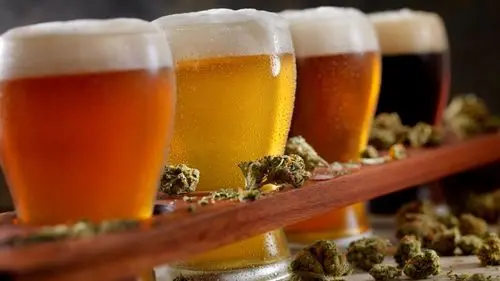
The cannabis industry keeps innovating, and one of its branches is beverages. Cannabis beverages are gaining space in the US markets, appearing in breweries and supermarkets, beyond dispensaries. Their e-commerce is another trend.
Composed of cannabinoids like tetrahydrocannabinol (THC) or cannabidiol (CBD), these beverages offer an alternative to traditional alcohol, with effects ranging from relaxation to euphoria.
In France, Portugal, Uruguay, and other countries where cannabis legalization is advancing, their trade has been growing. Already in Brazil... as well! But only with terpenes, without cannabinoids.
What are cannabis beverages?
Cannabis beverages are infused with compounds derived from the cannabis plant, such as THC, CBD, and terpenes present in the plant. Available in versions like beers, wines, cachaças, sodas, teas, mocktails, milks, and coffees, they provide sensory effects ranging from mild sedation to psychoactive stimulation, without the alcohol hangover.
In Brazil, as this practice is still prohibited, the solution that brands are finding to produce cannabis beverages is to infuse terpenes from the plant or similar to it. Terpenes are aromatic molecules from plants, influencing their flavor and effect. In cannabis, a 2016 Dutch study identified at least 120 of these odoriferous compounds.
List of cannabis beverages in Brazil and worldwide
Some of the Brazilian cannabis beers are:
- Verdivita, present in 2024 at the 10th Pilsner Fest, in Salvador;
- Balbúrdia Hemp, from Santa Catarina, which faced questionable persecutions in 2022 and 2023;
- Maine Berry Gelato, from Santos/SP, an India Pale Ale infused with terpenes from the Blueberry Gelato cannabis strain;
- Mun Rá, made by Cervejaria Mito from Rio de Janeiro, a traditional Bohemian pilsner with a bitter taste and resinous floral aroma, coming from the strains Black Widow;
- Blueberry Kush, native to Nova Lima (MG), a Double IPA "with a pine, dank, spice profile, and of course, berries in general";
- Natural Mystic, a Hazy Ale from cervejaria Luna, from São Paulo, with the addition of OG KUSH seasoning;
- Raja Immanuel Beria beer, from Hocus Pocus, available in São Paulo and Rio de Janeiro;
- Fumaçônica brewery, from Curitiba, has several options: Breeze Blonde, Flower Apa, Kunk Ipa, Hash Black Ipa, and Golden Kush Ipa, for example;
- Everbrew brewery, from Santos/SP, has the 24k beer and Ever Dunk Hop Hash, among others.
At Sechat, beer specialist sommelier Priscilla Colares has already explained that hops (Humulus lupulus), an ingredient in beers in general, and cannabis (Cannabis sativa) belong to the same botanical family, Cannabaceae, and share several biological similarities.
Regarding cannabis wines, nicknamed cannawine, there is the French label Burdi W, made from the Petit Verdot grape, with 250 mg of cannabidiol, plus a small dose of THC. Another brand is the Californian Rebel Coast, which excels in THC infusion and has sparkling wines and other beverages with the cannabinoid. As California is truly a standout in this area, another well-rated brand is the Californian Herbaceé, with CBD infusion, offering the Blanchette and Rosier sparkling wines, the latter mainly made with Grenache, Mourvèdre, and Cinsault grapes.
In Brazil, we have Cannab & Wine, whose Calimocho beverage has terpenes that emulate the Lemon Haze strain, while the Guara Wine refers to the Orange Kush strain. It is worth noting that no product from Cannab & Wine contains cannabinoids in its composition.
In Brazilian soil, also without THC or CBD, there is Hemp cachaça, from Cachaça Social Club, originating from Campos dos Goytacazes/RJ.
For coffee lovers, Café Blends Brasil offers sensory, terpene-infused coffees like Morning Kush and Orange California.
At Sechat, moving on to psychedelics, you can acquire Smush coffee, which has the alchemy of magic mushrooms.
Hemp milk also exists, such as those from Good Hemp, which are vegan and contain CBD.
Is the sale legal?
Yes, but with restrictions. Abroad, beverages with marijuana-derived THC can only be sold in regulated establishments. On the other hand, beverages derived from hemp, with up to 0.3% THC, have a little more freedom, such as in the US, where they were legalized by the 2018 Farm Bill and can be found in supermarkets and specialty stores.
On the other hand, Brazilian legislation prohibits the infusion of THC and CBD, with legal margin only for the use of terpenes.
How do these beverages affect the body?
The effects depend on the composition and concentration of THC, CBD, and terpenes. Beverages with low THC content (up to 5 mg) promote mild relaxation, while higher doses (above 10 mg) can generate intense euphoria. The combined consumption of CBD and THC tends to balance the effects, reducing anxiety.
Terpenes can have therapeutic, gustatory, and perhaps even sedative effects, depending on the quantity. When combined with cannabinoids, they produce the “entourage effect,” or “companion effect”, a synergy between such compounds.
Potency and consumption recommendations
The potency of cannabis beverages varies, reaching up to 100 mg of THC per serving. For beginners, it is recommended to start with doses of 2.5 to 5 mg. The effects can take from 30 minutes to two hours to manifest and last up to eight hours.
Before trying cannabis beverages, it is important to check local legislation, start with low doses, and wait for the effects before consuming more. Additionally, people with medical conditions should consult a healthcare professional.
With the increasing popularity of these beverages, consumers should educate themselves about effects and legislation for safe and responsible consumption.