Cannect acquires Pill and projects R$ 200M: The new health and cannabis hub
Cannect acquires Pill, expands to 17k medications, and forecasts R$ 200M. Allan Paiotti explains the merger on Sechat News. Check out the full article!

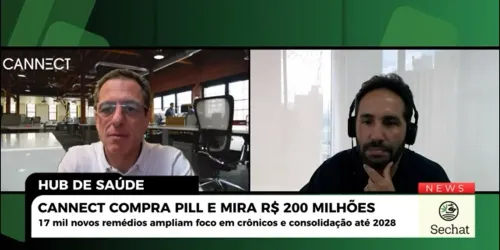
WATCH THE INTERVIEW WITH ALLAN PAIOTTI, CEO OF CANNECT:
1. Business Vision & Chronic Health Ecosystem
"Cannect was born in 2021 with the mission of providing an environment where we can take care of the healthcare journey of chronic patients, whatever their chronic diseases may be", Paiotti explained.
"The mindset never started with a vision strictly focused on medical cannabis. When Cannect was being set up, we crossed paths with the world of medical cannabis and saw an opportunity for a new therapy focused on chronic diseases (...) But the vision was always: as we grow and evolve, how would we expand the available therapies to treat other chronic conditions where there is no scientific evidence for the use of medical cannabis".
2. Portfolio Integration and Medication Line
"This opportunity to integrate Pill into the ecosystem closes this chapter of building the ecosystem where today we can address any type of chronic disease evaluated by any physician connected with Cannect", highlighted Paiotti.
"The pharmacy is a regulated entity; it has regulations from Anvisa and the Ministry of Health. The opportunity Pill brought us was to accelerate faster along this path, because Pill has been developing all digital solutions, digital subscription, delivery solutions, and connections with the pharmaceutical industry for 5 years. It was a fortunate alignment of the stars that allowed us to shorten this by many months".
3. Subscription Model, Recurrence, and Compliance with Anvisa
"The physician is the one who will define the therapeutic approach. If the treatment guidance offered by their doctor involves imported medical cannabis, we will advise and support the patient so that the import is completed and delivered to their home. If it is a cannabis product available via pharmacy, we have that through the pharmacy. And if an allopathic medication is prescribed alongside it, we will be able to offer it through Pill's portfolio of nearly 17,000 products".
4. Projection of R$ 200 Million in Revenue by 2028
"This is a projection we have essentially from this move to integrate this broader portfolio of therapies. We move from a universe focused on diseases treatable with medical cannabis to potentially treating what we estimate to be more than 200 million Brazilians with some type of chronic condition in Brazil".
"We are indeed looking at other moves that will be quite transformative for the coming months to strengthen this positioning as a consolidated primary care player".
When commenting on the fundraising track record and the entry of major investors into Cannect — such as the Supera funds (an asset manager bringing together Globo Ventures, Luciano Huck, Gilberto Sayão, and Duda Melzer), YaaX Capital (Mexico), and BluStone (a fund created by former Pátria Investimentos executives) —, Allan stressed that financial results are the consequence of sustainable work.
Since its founding in 2021, Cannect has raised a total of R$ 40 million. The most recent round occurred in 2023, led by Supera Capital and BluStone, with participation from YaaX Capital and family offices.
"I wanted to create a company without the pressure of doing something quickly in 2 or 3 years just to sell. The numbers must be the result of consistent work in a very large potential market (...) We want to build something sustainable, based on science, grounded, and the results will come naturally".
5. Analysis of the Cannabis Market, Anvisa, and Importation (RDC 660 vs. RDC 1015)
US Market and Rescheduling
"It's an industry worth over 30 billion dollars. It's hard to believe that with a stroke of a pen they will bring an industry of that size to its knees. I think it's a natural negotiation process (...) Adjustments will be made, but I don't think the impact will be as drastic as people are saying regarding limiting all THC products".
Brazilian Market: Importation (RDC 660) vs. Pharmacies (RDC 327 / 1015)
"The local market primarily bet on isolated CBD. What we are seeing happen is competition and a price war. Isolated CBD is a molecule inside a bottle; it's hard to differentiate other than by quality. On the other hand, we see demand from doctors seeking more complex formulations, Broad Spectrum and Full Spectrum, because clinical results have shown better outcomes".
"The import pathway will continue to be highly specialized, bringing product variability. My main plea for this sector is that we should stop this dispute between RDC 1015 (formerly 327) and RDC 660. RDC 660 is a great gateway for formulation variability, and Anvisa should help set rules to raise the bar on requirements and quality for these products, to the point where the evolution from 660 to 1015 is natural rather than a conflictual relationship".
The executive concluded by emphasizing the importance of continuing medical education and the responsible dissemination of medical cannabis to expand access in Brazil with scientific rigor and patient safety.
Reviewed by Sechat Editorial Staff