Experts and families demand implementation of law providing cannabis by SUS in Rio
Public hearing at Alerj discussed the delay in the application of the already sanctioned legislation

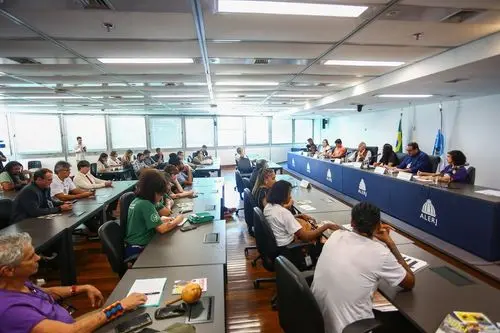
The Compliance Committee of the Legislative Assembly of the State of Rio de Janeiro (Alerj) held a public hearing on Monday (04/28) to discuss the Medicinal Cannabis Research Incentive Law and demand the implementation of the Cannabidiol Supply Law in SUS.
Although both laws have been sanctioned, the legislation has not yet been implemented in the state. The meeting, held at the Parliament headquarters, brought together sector representatives, health experts, and families of patients using the medication.
Ricardo Ferreira, a doctor and representative of the State University of Rio de Janeiro (UERJ), explained that a group was created to structure the implementation of the law, defining protocols for access to medications.
“Our work was to establish how the patient will access the medication and how the necessary dose evolution monitoring will be done. In addition, we discussed structural issues, such as the operation of outpatient clinics and the bidding process for acquiring products,” said Ferreira.
He stated that the final project was presented to the State government in February, focusing on the supply of medicinal cannabis for patients with refractory epilepsies, such as Lennox-Gastaut syndrome and Dravet syndrome.
Deputies demand compliance with the law
The deputy Carlos Minc (PSB), president of the Committee, emphasized that turning a law into an effective right requires institutional effort. He highlighted the role of the Compliance Committee as overseeing the application of legislation.
“The first step is to explain to people that the law exists. Most of them are unaware of their rights. We will use administrative, political, and even judicial arguments, if necessary, to ensure that the law is enforced,” said Minc.
Deputy Dani Monteiro (PSOL) also participated in the hearing and advocated for the distribution of medicinal cannabis in the public health system, especially for treating diseases affecting children and the elderly.
“The medicinal power of this plant is so strong that the positive results are undeniable, regardless of the patients' social class or region. Medicinal cannabis in SUS is already a law in the State, but it still needs to become a reality in distribution,” said the parliamentarian.
Families and associations emphasize the importance of free access
The director of the Association to Support Research and Patients of Medicinal Cannabis (Apepi), Claudete Oliveira, emphasized that access to cannabis should occur within the public system, with free distribution.
“It is not enough for medicinal cannabis to be approved by Anvisa or the Ministry of Health for importation. It must be within the Unified Health System. We need to distribute the medication to those in need,” pointed out Claudete.
Angélica Souza, mother of a teenager on the autism spectrum, described how the use of medicinal cannabis transformed her son's life. She advocated for expanding access to other families:
“After four years of using medicinal cannabis, today I have a young man at home with great improvements. I am grateful that cannabis entered his life because my son has improved a lot. And, like me, many mothers see cannabis as the only hope to improve their children's quality of life,” she said.
With information from the Alerj