Medical Cannabis Breaks Cycle of Chronic Pain and Changes Patients' Routine in Brazil
Ledyane, who resumed running after three years of treatment, reflects a growing movement among doctors and patients seeking alternatives to conventional drugs

Published on 11/19/2025
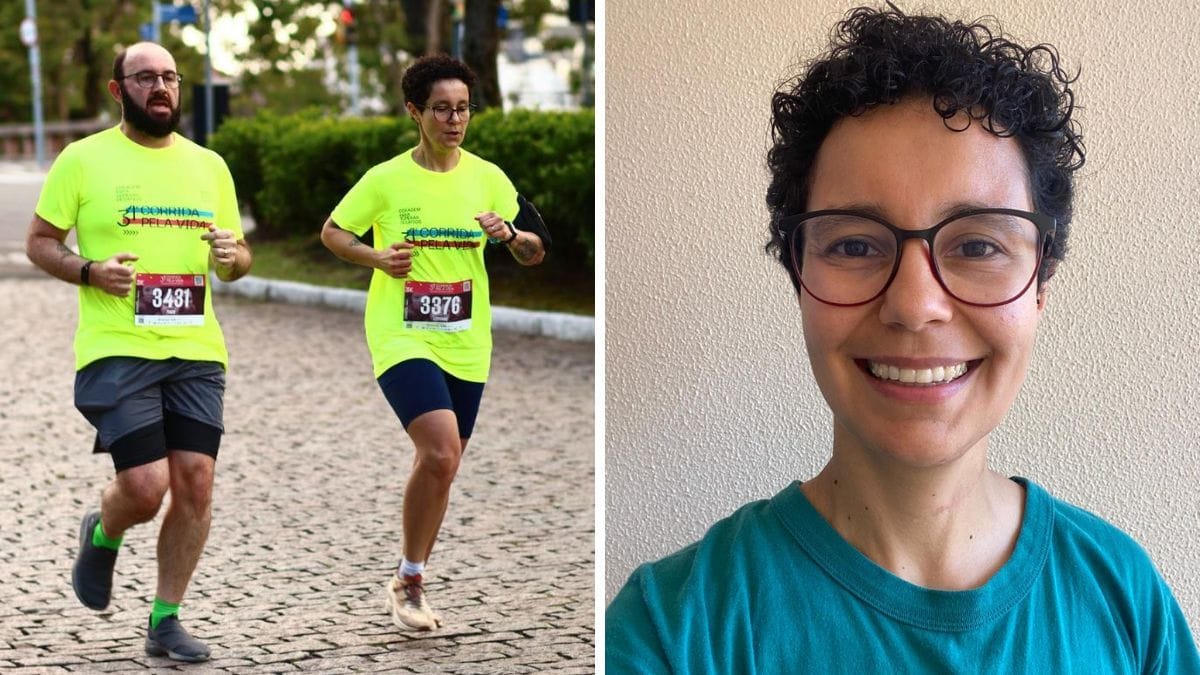
Ledyane Rocha Uriartt, 39, diagnosed with rheumatoid arthritis during the "Race for Life" at the Children's Cancer Institute of RS (ICI), where she achieved the goal of three kilometers. Image: Personal Archive
Medical cannabis has been established as an effective alternative for the treatment of chronic pain, especially when conventional medicine fails or causes severe side effects. More and more patients are finding in cannabis therapy a way to regain quality of life, reduce the use of corticosteroids and opioids, and even resume physical activities.
Ledyane Rocha Uriartt, 39, diagnosed with rheumatoid arthritis, after three years of treatment with the plant, returned to physical activities. On November ninth, she participated in the "Race for Life" organized by the Children's Cancer Institute of RS (ICI), where she achieved the goal of three kilometers.
"The Ledy from before would hide, sparing herself, preserving herself, without running, without weightlifting. The pain is so intense that I can't even think of anything else. Today I'm fighting the pain with physical activity. It's a lot of energy."
Diagnosed in 2018, for over 15 years, she was told that her joint pains were just "growing pains." Living in Porto Alegre (RS), Ledyane began the conventional journey to treat the autoimmune disease, a path she describes as full of severe side effects.
"I experienced hair loss, periodic liver care," as well as a direct impact on bone structure. "Today, at 39, I have early signs of osteoporosis."
Even achieving disease remission (when medication stabilizes symptoms), the impact of traditional medications was high. "I take chloroquine, which has side effects on vision, potentially causing irreversible damage," she explains.
It was in this scenario that, in 2022, she found in medical cannabis a way to modulate treatment and regain quality of life. "I can only reduce significant amounts of both chloroquine and corticosteroid due to cannabis," she states.
The transformation, she says, was total. Ledyane, who now works as a cannabis co-therapist, recalls the adaptation. "In the early days, CBD made me feel accelerated, waking up at three in the morning ready for the day." Today, she understands the therapy and her own body.
"I understand when I need a drop more or less. It gives me the energy to start the day. When I'm in crises, the anti-inflammatory is cannabis, not another medication with side effects."
The main reason for using medical cannabis
Ledyane's story is not an isolated case. She is the face of a statistic that defines the medical cannabis market in Brazil. According to the "Insights and Opportunities Report from the 4th Edition of the Medical Cannabis Fair," produced by the Sechat portal, pain is the main motivation for therapy.
The report, conducted during one of the largest business fairs in Latin America, which in 2026 will be renamed Cannabis Fair, surveyed 4,671 people, including over 1,200 doctors, and shows that among the 72.59% of doctors who already prescribe cannabis, the three main treatments are for pain (22.52%), sleep induction (18.81%), and mood disorders (17.20%).
But why has medical cannabis gained so much space precisely where conventional medicine already offers an arsenal of analgesics, anti-inflammatories, and opioids? According to Dr. Laerte Rodrigues Junior, the answer lies in the saturation of the traditional system.
The body has receptors for analgesics, anti-inflammatories, and opioids," explains the doctor. "If you persist in treatment chronically, you end up saturating the receptors and reducing the effectiveness of each of them."
Dr. Laerte points out that, in cases of long-standing chronic pain, 10 or 15 years, patients arrive with frustrated responses to the "multipharmacy." "Since the patient is new to cannabis treatment, we are in a chronological advantage regarding treatment," he says. "There is indeed an excellent and enormous advantage of cannabis treatment for chronic pain."
The advantage of cannabis, according to Dr. Laerte, lies in its complexity. It is not about a single molecule but a rich extract that interacts in multiple ways in the body.
"We have a pharmacy inside each bottle, with this the broad analgesic and anti-inflammatory effect is superior to conventional treatment, in the medium and long term."
This complexity allows for multifaceted treatment. "Directly for pain, THC prevails, among other cannabinoids like CBG, which is an excellent anti-inflammatory," says the doctor. "For anti-inflammatory and analgesia, in a less intense way, we have CBD".
Ledyane's account confirms the practice. "Today I use the association oil — THC-rich oil. I also use an imported oil CBG + CBD".
The Sechat report supports this approach, indicating that the preferred administration form by prescribing doctors is Tincture or oil (36.7%), followed by Gum (15.22%) and Muscle Pain Cream (11.74%).
The Role in dissociating pain and suffering
The impact of treatment with medical cannabis goes beyond physical relief. Dr. Laerte highlights one of the most potent properties of treatment, especially THC, the ability to "dissociate pain and suffering".
If the patient starts treatment only with THC, there will be a decrease in pain, perhaps not complete, but the association between 'pain and suffering,' this can be broken." While THC acts on this perception, CBD complements well-being.
"CBD is an excellent anxiolytic. That is, discomfort, stress, sleep imbalance, anxiety, everything can be controlled with CBD," concludes the doctor.
For Ledyane, who found cannabis after the death of her father-in-law, who encouraged her to use the plant, the path was to "believe in treatment and in pain relief".