Verão da Lata: From the Sea to the Big Screen Nearly 40 Years Later
The "Verão da Lata" has become a movie nearly 40 years later. Look back at the story of the cans that washed ashore on Brazilian beaches and find out when to watch.


It was September 1987 when the sea decided to hand Brazilians a story that sounded straight out of a movie. Silver cans began washing up on the beaches of the Southeast coast, filled with cannabis. The episode became known as the Verão da Lata ("Summer of the Cans") and, nearly four decades later, has found a new life on the big screen.
But before turning into a film, this story was headline news, beachside chatter, a generation's memory, and even an inspiration for Brazilian pop culture.
The story of the Verão da Lata began at sea
It all started with a vessel called the Solana Star.
In 1987, the ship departed Australia bound for the United States carrying a massive shipment of cannabis. According to reconstructions published by Folha de S.Paulo and recently revisited by the Catalan magazine Cáñamo, there were around 14,000 cans, each containing approximately one kilogram of the herb.
Trouble struck when the ship approached the Brazilian coastline.
Fearing interception by the authorities, part of the cargo was dumped overboard before the vessel entered Guanabara Bay. And that was when the story took a turn no one could have anticipated.
Ocean currents did the rest.
The cans began washing up on the beaches of Rio de Janeiro and other coastal areas. Some were seized by the police, but others ended up in the hands of everyday beachgoers simply enjoying another summer day.
And that is how an international smuggling operation transformed into one of the most curious episodes in the history of Brazilian cannabis culture.
When the cans became part of the culture
Remarkably, the Verão da Lata did not remain confined to the crime beat.
The story spilled into the streets.
According to Folha, the slang expression “da lata” ("from the can") began to be used to describe something considered top-notch. The silver cans also showed up on T-shirts and made their way into Carnival, illustrating how a police event could quickly be absorbed by popular folklore.
It is one of those Brazilian tales that seems to grow every time it is retold.
And perhaps that is precisely why it stayed alive.
Nearly 40 years later, there is still widespread curiosity about that summer when the sea washed an unexpected cargo onto the sand.
LEARN MORE: Cannabis in Brazil: Between Historical Roots and Ancestral Spirituality
What does the Verão da Lata reveal about Brazil?
Far more than the story of discarded contraband, the episode offers a window into a Brazil emerging from a military dictatorship and going through profound social and cultural shifts.
Cannabis was still surrounded by heavy repression and stigma. At the same time, it was beginning to claim an increasingly visible space in music, the arts, the press, and youth culture.
The incident with the cans ended up becoming part of that cultural zeitgeist.
The report by Cáñamo captures precisely this cultural dimension, noting that the story left its mark on T-shirts, music, and everyday slang.
It is a curious memory because it was born out of an illicit enterprise, yet wound up becoming a cultural hallmark.
And now it is cinema's turn to tell this story.
Verão da Lata hits the screen nearly 40 years later
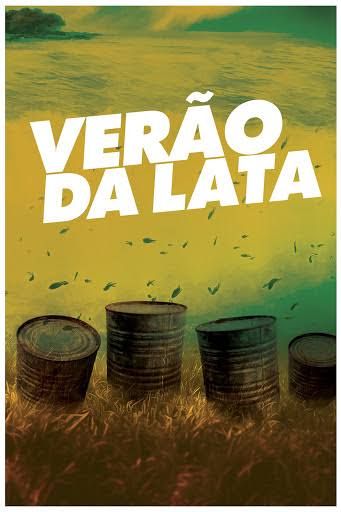
The filmmaker who decided to adapt this episode into a crime comedy is director Santiago Dellape.
The feature film Verão da Lata, produced by H2O Films, already had its world premiere at the closing of the 59th Festival de Brasília do Cinema Brasileiro, on September 19, 2026. Its theatrical release across Brazil is scheduled for November 19, 2026.
The production does not intend to merely stage a historical reenactment of the 1987 events.
The real story serves as a springboard for a fictional narrative.
In the film, federal police officers Sandra, played by Samantha Schmütz, and Brasa, played by Babu Santana, must investigate the origins of the cans washing ashore on local beaches.
The pair have contrasting personalities and find themselves caught in an investigation involving drug traffickers, corrupt cops, reporters, hustlers, and local youths who see the unexpected cargo as an opportunity.
Who is in the cast of Verão da Lata?
Along with Samantha Schmütz and Babu Santana, the film brings together Humberto Martins, Leandro Firmino, Rafael Saraiva, Igor Jansen, Ademara, Paulinho Serra, and Alane Dias, among other names.
For Alane, the feature also marks her film debut.
She plays Marina, a young woman who gets entangled in the story of the cans that reach the shores.
The casting choices reflect the director’s goal of building a 1980s-set crime comedy without treating the historical episode as if every fictional character were an actual real-life participant.
In an interview with Jornal de Brasília, Dellape explained that the production needed to depart from certain real-life elements, such as names and nationalities, to construct the fiction.
LEARN MORE: A Planta: Beto Brant's New Cannabis Film Debuts in Brazilian Theaters
When does the film Verão da Lata premiere?
Now, the most famous can in Brazilian culture is set to find a new home: the big screen.
Verão da Lata opens in Brazilian theaters on November 19, 2026, distributed by H2O Films.
There is perhaps something uniquely poetic about this story.
In 1987, the sea carried those cans far away from the crew that loaded them onboard. Decades later, they return through the shores of collective memory.
They no longer arrive through the water.
They arrive through cinema.
Sources and references
- Folha de S.Paulo — report from October 13, 1994, on the origins of the episode and the vessel Solana Star.
- Cáñamo — “Las latas de cannabis que llegaron a las playas brasileñas,” published on October 2, 2026.
- Cáñamo — report on Daniel Paiva and the place of cannabis comics in Brazil.
- Filme B — credits and release date for Verão da Lata.
- Jornal de Brasília — interview with Santiago Dellape and information on the premiere at the Festival de Brasília.
- Metrópoles — information on the cast and the film's theatrical release.