Anvisa receives letter questioning "criminal background check requirement" for cannabis cultivation
Adesaf Institute points out unconstitutionality in vetoing workers with a criminal history in research areas and requests a review of the measure

The Articulation Institute of Social Technologies and Formative Actions (Adesaf) filed Letter No. 75/25 with the National Health Surveillance Agency (Anvisa). The document contests a specific section of Vote No. 200/2025, reported by director Thiago Lopes Cardoso Campos, which authorized Embrapa to carry out cannabis cultivation for research purposes.
The controversy revolves around a security requirement that prohibits individuals with criminal backgrounds from being present on the premises. The entity classifies this measure as unconstitutional and discriminatory. In response, the agency stated that the contribution will be considered in future regulatory discussions.
Impact on cannabis cultivation and associations
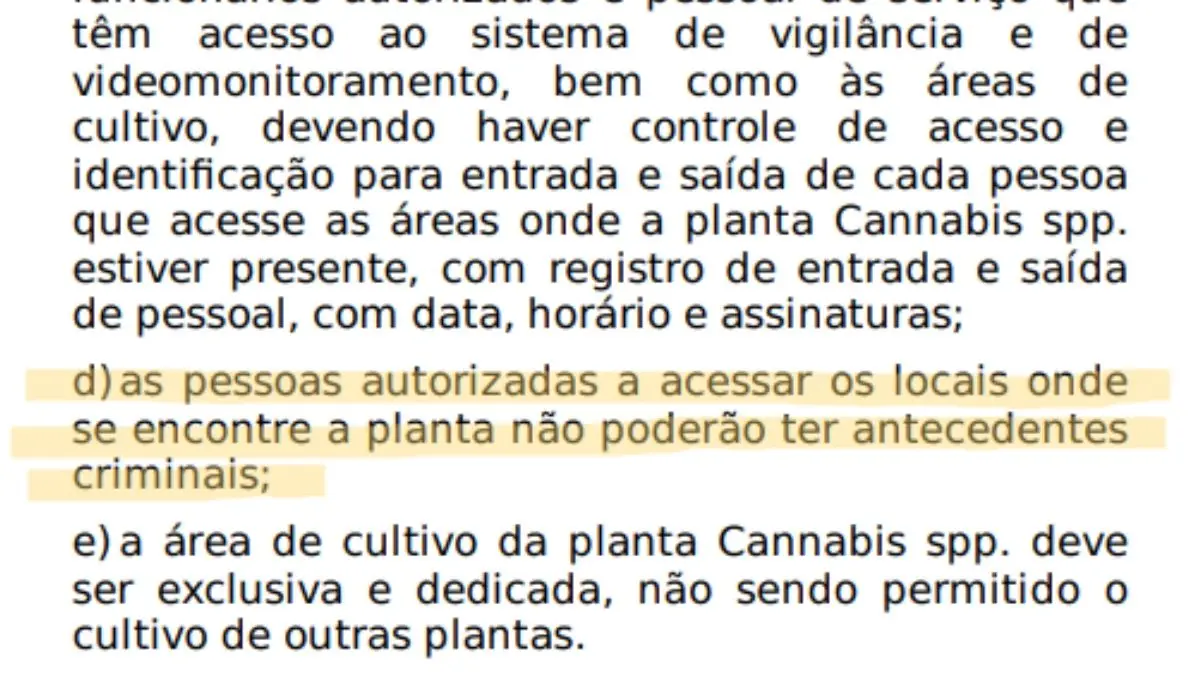
The contested document was approved exceptionally to avoid harming the funding of Embrapa projects, along with Finep. Among the imposed control measures, item II, sub-item "d" states that individuals authorized to access areas where the plant is located must not have criminal backgrounds.
For the Institute, maintaining this rule directly impacts the operation of patient associations. The entity argues that many collaborators have past criminal records related to the drug legislation under discussion, but today operate legally in support of cannabis cultivation.
"From a practical standpoint, the greatest impact would be on patients. When you weaken cannabis associations, you directly weaken care. This provision could exclude people who are currently essential for the functioning of the associations and for the sustainability of care itself," said Fernanda Gouveia, president of the Adesaf Institute.
Legislation and security in cannabis cultivation
The letter argues that the requirement violates Law No. 9.029/1995, which prohibits discriminatory practices in the workplace, as well as Summary 444 of the Superior Labor Court (TST). According to the organization, the Agency's competence should be limited to sanitary aspects of cannabis cultivation, without creating labor barriers.
"We emphasize that criminalization, besides being prejudiced in the context of the vote, is also unconstitutional. Remembering that it is not the competence of Anvisa to create mechanisms of criminalization, but rather of control and sanitary rules," added the entity's representative.
The security of operations would already be ensured by other mechanisms in place, such as 24-hour video monitoring and biometric control. The document sent to the agency argues that such measures make background checks redundant in cannabis cultivation operations.
"There are workers who had criminal backgrounds in the past, have served their sentences, resumed their lives, and today act with extreme responsibility in the cultivation of medicinal cannabis. Maintaining this type of prohibition means ignoring these real stories," Gouveia highlighted.
Anvisa's position on cannabis cultivation
Anvisa clarified that the decision regarding Embrapa followed a rationale adopted in previous cases, aiming for immediate legal security. However, the regulatory agency indicated openness to reconsider the questioned point about cannabis cultivation.
In response, Anvisa stated that "the decision in question was made in a context of exceptionality." The agency also assured that, "as the debate for regulation is ongoing, the Association's input will be considered in the regulatory discussion."
The Adesaf Institute is studying evaluating other institutional measures if the suppression of the provision does not occur through administrative means. The goal is to prevent the rule from becoming a precedent for the future definitive regulation of cannabis cultivation in the country.
"I see this vote much more as part of a maturation process of Anvisa regarding medicinal cannabis than as a closed guideline. The agency has demonstrated the ability to adjust its actions when well-founded technical contributions arise," concluded Gouveia.