Hemp plywood withstands 200°C without catching fire
Hemp brick stores carbon and can gain a new purpose after use. Discover ICT's experiments on Portal Sechat.

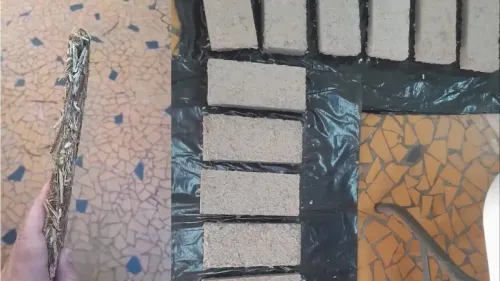
ICT Cannabis Brasil is developing experiments with plant fibers to demonstrate how renewable raw materials, such as hemp and corn, can be used in the production of bricks, plywood, furniture, and components for civil construction.
Read also: The country that still destroys cannabis: seizure of 40,000 plants in MG
The tests seek to develop materials aligned with the international carbon emission reduction targets advocated by the United Nations (UN). The proposal is to replace higher-impact industrial processes with a bioprocess based on renewable sources and lower energy consumption.
According to Fabrício Zardo, director of ICT Cannabis Brasil, the hemp brick undergoes a cold-drying process and eliminates kiln firing—a common step in the manufacturing of conventional ceramic bricks associated with fuel consumption and greenhouse gas emissions.
During cultivation, plants such as hemp and corn absorb carbon dioxide from the atmosphere. Part of this carbon remains stored in the material after manufacturing. When the amount captured exceeds the emissions generated throughout the production process, the product can achieve a negative carbon balance.
“With renewable sources such as hemp and corn, we can achieve carbon negativity. This happens when the manufacturing process is so efficient that the raw material captures more carbon from the atmosphere than what is emitted to produce the brick,” Zardo explained.
Classification as a carbon-negative material, however, depends on a comprehensive life cycle assessment, taking into account cultivation, transportation, manufacturing, use, and final disposal.
Read also: Regulation of cannabis and hemp in Brazil: a milestone for 2025
Heat jet test at 200 °C
In one of the experiments, a piece produced with the material was subjected to a 200 °C heat jet. According to ICT Cannabis Brasil, the sample did not ignite, form embers, or release smoke during the test.
The resistance was deemed satisfactory by those in charge of the experiment. According to the institute, the temperature of the piece increased by only 10 °C during exposure.
The result indicates thermal resistance under the specific conditions of the trial. To formally classify the product regarding fire reaction and fire resistance, standardized tests and technical certifications applicable to construction materials are still required.
A material with a second life cycle
Another differentiator being studied is the possibility of reusing the brick after its use in construction.
“The brick does not end at construction. It has a second life cycle,” Zardo stated.
According to the director, the material can be reused as animal bedding or returned to the soil, contributing to a circular production model. The idea is to give the product a new use after its initial application, reducing waste generation and reliance on conventional recycling processes, which can be costly.
The project also evaluates the material's antibacterial properties and the environmental potential associated with hemp cultivation, including phytoremediation—a process by which certain plants can remove, immobilize, or reduce contaminants in the soil.
In addition to bricks, experiments with plywood show that plant fibers can also be used in the manufacturing of furniture and other components. The initiative broadens the debate on hemp use beyond the medicinal and pharmaceutical fields, presenting the plant as a viable raw material for a more circular, renewable, and lower-impact industry.