Medical cannabis: 4 specialties lead prescriptions
Neurologists and psychiatrists show higher prescription intensity for medical cannabis, while other specialties have a larger number of physicians. Learn more


The medical cannabis market in Brazilian pharmacies is concentrated across four specialties: general practice, psychiatry, pediatrics, and neurology. Together, they account for 69.4% of the share of prescriptions recorded in the 12-month period ending in April 2026.
The data was presented by Close-Up International during the Congresso Brasileiro da Cannabis Medicinal (CBCM 2026). The survey considers prescriptions for cannabis products sold in pharmacies and drugstores — therefore, it does not fully include other channels, such as individual imports and patient associations.
The analysis also shows that the number of cannabis-prescribing physicians in the pharmacy channel jumped from 54,258 to 69,794, an increase of 28.6% compared to the previous period.
Over the same timeframe, the volume of physical or digital prescriptions went from 354,302 to 476,448, an increase of 34.5%. The average rose from 6.5 to 6.8 prescriptions per physician.
Which specialties prescribe cannabis the most?
The four specialties highlighted in the survey are identified by the acronyms CLG, PSQ, PED, and NEU:
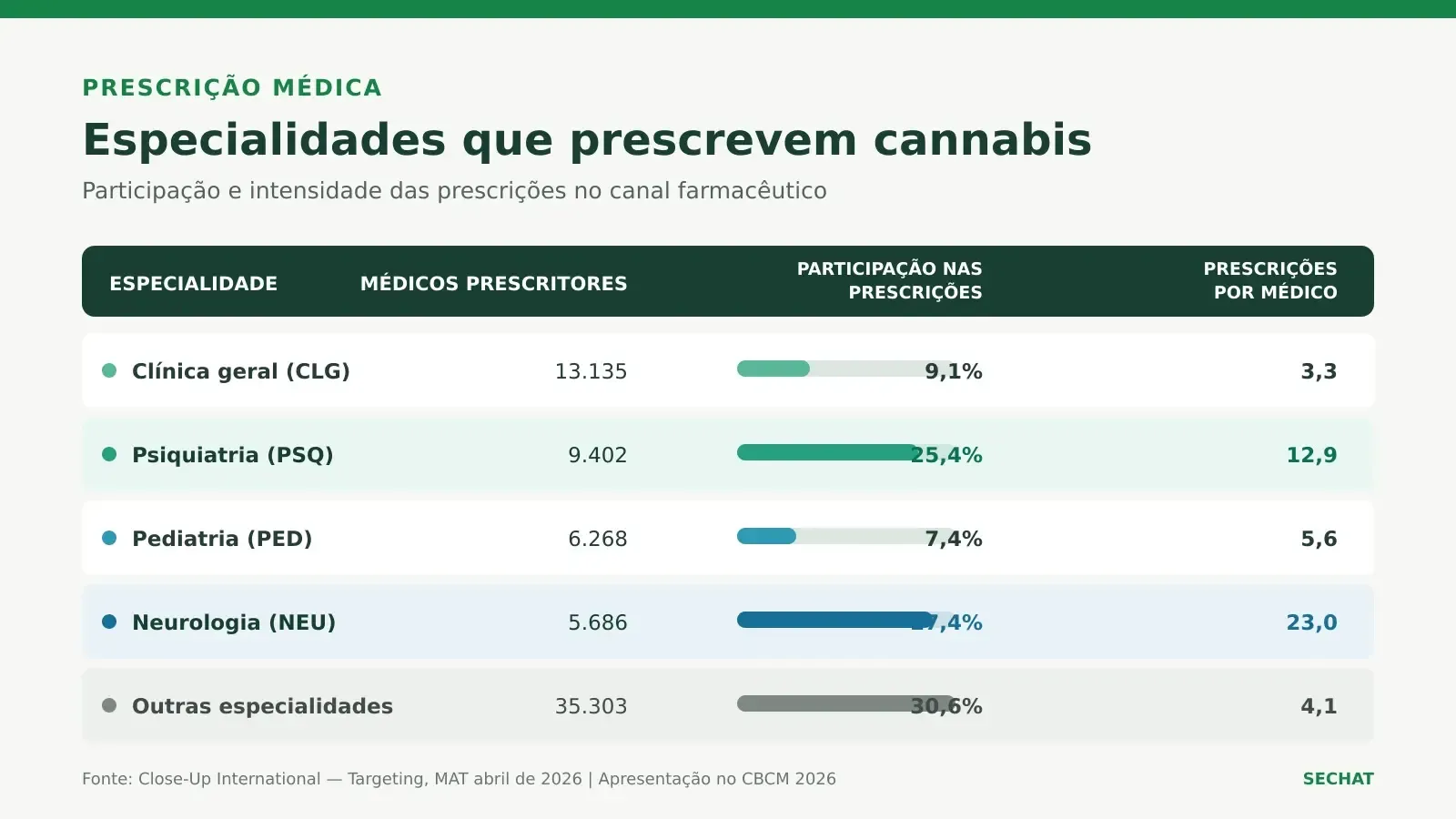
Combined, the four areas account for 34,491 physicians, equivalent to approximately 49.4% of the 69,794 prescribers identified.
The numbers, however, reveal two distinct forms of leadership. General practice has the largest base of prescribing professionals, while neurology records the highest prescription intensity, averaging 23 prescriptions per physician.
Neurology leads in prescription intensity
Neurology accounts for 27.4% of prescriptions, despite comprising 5,686 physicians — the smallest contingent among the four analyzed specialties. Each neurologist wrote an average of 23 prescriptions during the period.
This intensity may be linked to the presence of medical cannabis in discussions on neurological conditions, especially difficult-to-manage cases. Among the conditions monitored by the specialty are epilepsy, multiple sclerosis, and migraine.
In epilepsy, particularly in rare syndromes resistant to conventional treatments, cannabidiol has more consolidated clinical evidence. Sechat's Diseases section features studies on the use of cannabinoids in patients with seizures, including research with children diagnosed with severe epilepsy.
This does not mean, however, that all prescriptions written by neurologists have epilepsy as the indication. The database provided indicates the medical specialty, but does not detail the diagnosis associated with each prescription.
Psychiatry represents 25.4% of prescriptions
Psychiatry ranks second in market share, with 25.4% of prescriptions. A total of 9,402 prescribing psychiatrists were identified, with an average of 12.9 prescriptions per professional.
The growth of cannabis in this field aligns with scientific interest in the action of cannabinoids on conditions related to mood, sleep, and behavior. Sechat's Diseases section compiles research on cannabis and anxiety, depression, insomnia, and post-traumatic stress disorder.
Evidence, however, does not carry the same weight across all conditions. Studies on CBD and anxiety show relevant initial findings, but larger, well-controlled clinical trials are still needed. Products containing THC also require careful evaluation, particularly in patients vulnerable to psychiatric side effects.
General practice has the highest number of prescribers
General practice takes first place when the metric is the number of physicians: there are 13,135 prescribers. This group accounts for 9.1% of prescriptions, with an average of 3.3 prescriptions per professional.
The result suggests a large base, but with less recurrent use compared to neurologists and psychiatrists. Because general practitioners treat patients with a wide variety of conditions, cannabis may appear in therapeutic discussions involving pain, sleep, cancer-related symptoms, and palliative care.
Chronic pain is one of the conditions with the highest volume of research on cannabinoids. Sechat's dedicated page brings together reviews and studies related to the use of CBD, THC, and other plant compounds across different types of pain.
Even so, response to treatment can vary depending on the origin of the pain, product formulation, dosage, and the patient's clinical status.
Pediatrics gathers over 6,000 prescribers
Pediatrics brings together 6,268 prescribing physicians and accounts for 7.4% of cannabis prescriptions in the pharmacy channel. The average is 5.6 prescriptions per pediatrician.
Among the topics linking medical cannabis to the specialty are refractory epilepsy and Autism Spectrum Disorder (ASD). In the case of autism, research investigates potential effects on associated symptoms such as irritability, sleep disturbances, and disruptive behaviors, though evidence is still developing.
In pediatric epilepsy, the scientific landscape is different: specific CBD formulations have more robust clinical studies for certain rare syndromes. Even in these cases, treatment requires medical monitoring, individualized dosage adjustment, and observation of potential drug-drug interactions.
New physicians drive the cannabis market
Of the 69,794 physicians identified in the period, 43,230, or 62%, began prescribing cannabis in the past year. The other 26,564 were already present in the previous database and increased their prescription volume by 27.7%, rising from 11.1 to 14.2 prescriptions per physician.
The survey also highlights 27,694 professionals classified as “lapsed,” meaning they prescribed in the previous period but were not identified as prescribers in the current period. This group had low recurrence, averaging 1.4 prescriptions per physician.
The data indicates that the expansion of the pharmaceutical cannabis market is mainly driven by the entry of new professionals. At the same time, the difference between the number of physicians and prescription intensity shows that neurologists and psychiatrists maintain a more recurrent activity within this channel.
It is important to emphasize that these figures do not measure the entirety of the Brazilian medical cannabis market. The scope presented considers sales and prescriptions captured in pharmacies and drugstores. Anvisa-authorized imports, products supplied by associations, specialized clinics, court orders, and public procurement have their own dynamics and may alter the overall landscape.