STF set 40g as the limit, but 55% of marijuana convictions remain as trafficking
CNJ re-evaluated nearly 30,000 cases involving cannabis, only 13% of convictions were changed; experts point to the influence of the 'police word' and institutional resistance in state courts


The National Justice Council (CNJ) released the results of the 1st Penal Process Mutirão of the Just Sentence, an initiative carried out in partnership with 33 courts across the country. The CNJ Mutirão reviewed a total of 86,000 processes of different natures, resulting in the release or sentence revision of 9,000 people.
One of the central focuses of the work was the analysis of convictions for possession or trafficking of marijuana over the past eight years. The criterion used was the thesis established by the Supreme Federal Court (STF) in July 2024, regarding possession of up to 40 grams or six female plants.
In total, 29,725 cases were reanalyzed during the CNJ Mutirão. Of these, only 3,813 convictions (about 13%) were immediately changed. In contrast, the conviction for trafficking was maintained in 54.9% of the processes. Another 7,434 cases were forwarded for the Defense and Public Ministry's input.
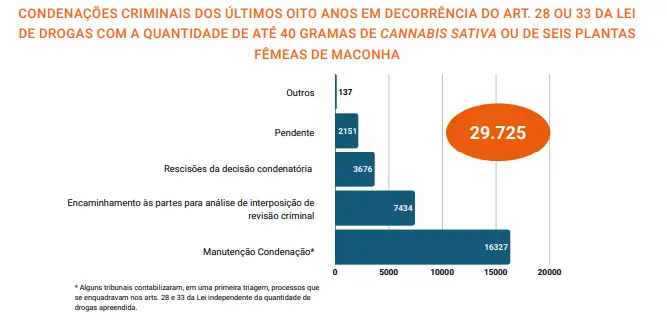
The specific focus on cannabis reveals a challenging scenario. The data shows that the STF's decision, which decriminalized possession for personal use, still faces practical barriers to generate a massive impact on decarceration.
Impact of the CNJ Mutirão faces institutional resistance
According to lawyer Emílio Figueiredo, the numbers reflect the timidity of the Supreme Court's decision and the state’s punitive culture. He assesses that the real impact observed in the CNJ Mutirão was "well below initial expectations".
“The STF's decision did not adequately address the issue by setting low objective criteria in light of the consumption profile of the Brazilian user,” Figueiredo evaluates. He also points to an ideological barrier in the application of the law.
“The Brazilian Judiciary is resistant to decarceration, preferring to keep people imprisoned for small quantities rather than extending the STF's decision and using the mutirão to review more processes. The numbers suggest only a pinpoint correction of very glaring cases,” the lawyer adds.
The barrier of the 'Police Word'
The report indicates that the maintenance of convictions occurs, in large part, due to a caveat in the STF's decision. The quantity of drugs, by itself, does not define the crime, as the presence of other elements of evidence can configure trafficking.
For lawyer Murilo Nicolau, it is at this point that the "trap" of the penal system lies. According to him, the construction of the police inquiry is often designed to circumvent the objective criteria evaluated in the CNJ Mutirão.
“What we need to keep in mind is that the STF's decision can only be applied when there are no indications of trafficking. And then comes a very relevant issue, the police officer is trained to frame the person in trafficking and reinforce this in the hearing,” Nicolau explains.
The lawyer details the use of standardized reports, known as "flagrant kit", which prevent the revision of sentences. “Often, when the police officer reports the arrest, he uses words like 'hiding from the patrol car', 'location known for trafficking' or says that the person 'is already known'. They mention exchanged money or cell phones,” he states.
Nicolau emphasizes that this dynamic harms those who should be benefited. “The harsh truth of the judiciary today is that people are convicted based solely on the police word. Because who is going to testify in favor of someone who was arrested for trafficking?”
Regional inequalities in the data
The report also exposed the geographical inequality in the application of justice in Brazil. The evaluation pointed out that 83% of the punishment changes made by the CNJ Mutirão were concentrated in just three states: Santa Catarina (1,560), São Paulo (1,113), and Minas Gerais (485).
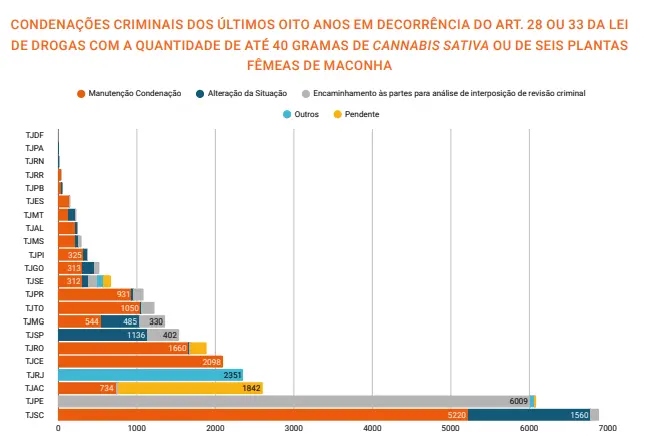
Image: Archive 1st Penal Process Mutirão of the Just Sentence
In the Northeast, the situation is critical. Lawyer Ítalo Coelho highlights the data from Ceará as an example of the persistence of the "prohibitionist metric". “The real impact was very small. In Ceará, for example, there was no change,” Coelho points out. There were 2,098 cases reviewed, and the conviction was maintained in all.
In Pernambuco, a state that had the second court with the highest number of evaluations, 6,009 cases did not have an immediate outcome. They were classified as "Forwarding to the parties for analysis of criminal revision interposition";
For Coelho, the interpretation remains subjective. “The prohibitionist metric continues to be present when analyzing, because the very decision states that a person can be considered a trafficker with less than 40 grams, or less than 6 plants. Or the opposite: was considered a user with much more,” he concludes.
Technical advances enabled
Despite the criticisms regarding the limited number of releases, for the CNJ, the mass review process demonstrates a technical evolution of the Judiciary. In the report, the Council stated that it is likely that the courts have analyzed all recent and relevant judgments on the matter.
Murilo Nicolau agrees that the technological structure facilitated the realization of the CNJ Mutirão. “I believe they have indeed focused on this, because the digitization and computerization of our judiciary have completely changed the scenario,” he says.
"The difference in the speed of processes from a few years ago is palpable. I am confident that this mutirão was indeed well executed on the technical side,” Nicolau concludes.