SUS-SP records more than 33,000 Cannabidiol dispensations since 2024
Data presented by Rafael Cairê de Oliveira dos Santos during a public hearing of the Parliamentary Front for Medicinal Cannabis and Industrial Hemp at Alesp show the evolution of public care and the territorial expansion of treatments in the State of São Paulo.

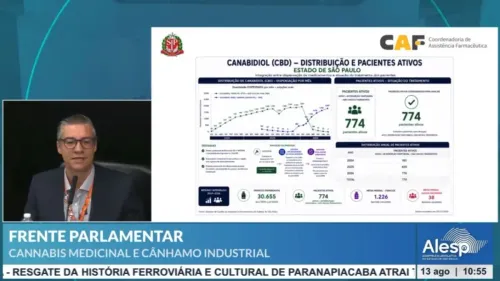
During the public hearing of the Parliamentary Front for Medicinal Cannabis and Industrial Hemp, held at the Legislative Assembly of the State of São Paulo (Alesp), the State Health Secretariat of São Paulo (SES-SP) presented a detailed report on the supply of Cannabidiol (CBD) in São Paulo's Unified Health System (SUS).
The data were presented by Rafael Cairê de Oliveira dos Santos, Technical Health Director at the Pharmaceutical Care Management Group of the Pharmaceutical Care Coordination (CAF/SES-SP). The presentation highlighted the expansion trajectory and consolidation of access to treatment through the public health network since state regulation.
Significant growth and expansion into the state interior
According to a survey by the Pharmaceutical Care Management System of the State of São Paulo, the total volume of care recorded a significant jump between 2024 and 2025, maintaining high levels in 2026.
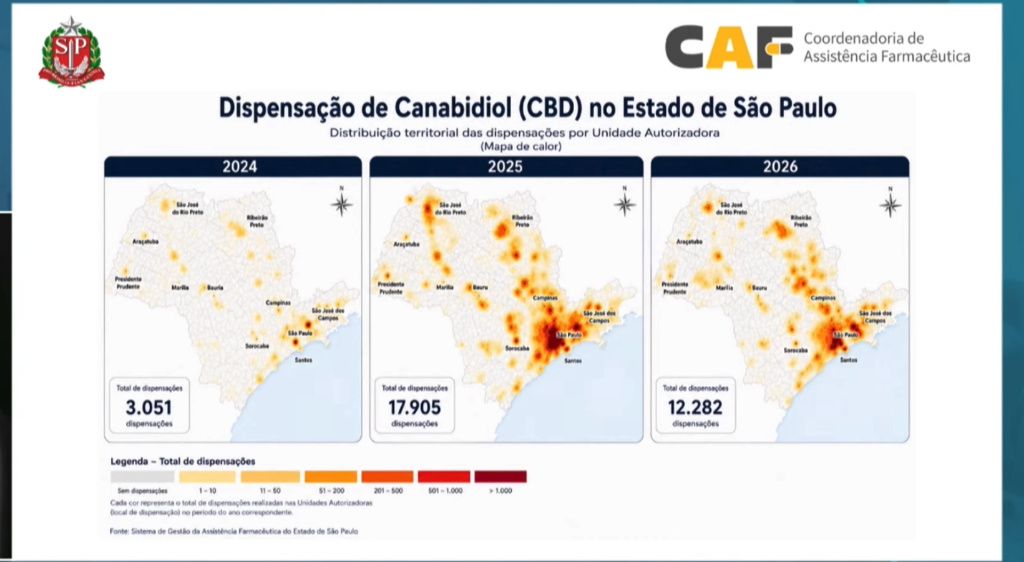
The official numbers of total dispensations by Authorizing Unit show the following evolution:
- 2024: 3,051 dispensations performed;
- 2025: 17,905 dispensations performed;
- 2026: 12,282 dispensations performed.
The territorial mapping (heat map) displayed during the event showed that, in the first year of implementation, patient care was predominantly concentrated in the Metropolitan Region of São Paulo and major regional hubs. In subsequent years, however, there was significant decentralization toward the state interior, reaching Authorizing Units in regions such as Campinas, Ribeirão Preto, São José do Rio Preto, Bauru, Sorocaba, and Vale do Paraíba.
Advancement of public policies and SUS challenges
The report presented at the Parliamentary Front reinforces the direct impact of state legislation on access to medicinal cannabis on the routine of patients treated by SUS. The jump from just over 3,000 dispensations in 2024 to nearly 18,000 in 2025 reflects the structuring of request, evaluation, and product delivery workflows.
The presentation of data at Alesp also served to guide debates on improving public pharmaceutical care, the clinical follow-up of covered patients, and the expansion of the budget dedicated to incorporating treatments into the state health network.